Sober Curious Is Not Quitting, It Is Choosing
· 11 min read
The sober curious movement asks people to question each drink instead of drinking on autopilot. It is not a promise to quit forever, and that is exactly why it has spread.
Some people stop drinking because they have to. A growing number are doing something quieter. They look at the glass in front of them and ask whether they actually want it, and that small pause now has a name. It is called being sober curious, and it is less about quitting alcohol than about choosing, on purpose, one occasion at a time.
The sober curious approach makes no pledge and demands no label. Nobody has to announce anything, join anything or declare that they will never drink again. The whole method is a question, asked before the first sip rather than regretted after the last one.
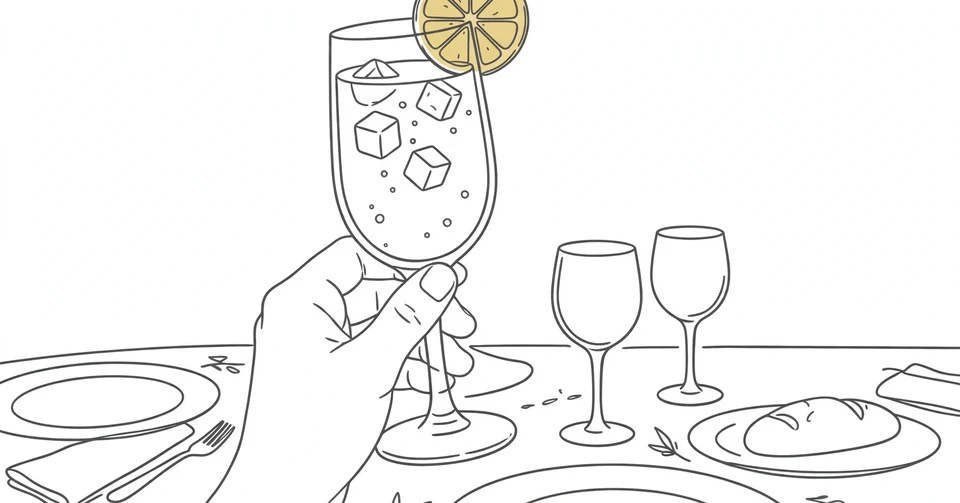
That question turns out to travel well. In the few years since the phrase appeared, sober curious has grown from one writer's book title into a shelf of drinks, a style of bar menu and a way for people in very different drinking cultures, including Japan's, to say no thanks without making it a speech.
A book that gave the pause a name
The phrase was popularised by Ruby Warrington, a British lifestyle journalist who had been a features editor at the Sunday Times Style magazine. Her book Sober Curious was published by HarperOne at the end of 2018, and it was not written from the far side of a dramatic collapse. Warrington drank the way her social world drank, at launches, dinners and deadlines, and had started to wonder why the habit felt automatic even when it was not much fun.
Her definition is the one the sober curious movement still uses. To be sober curious, she wrote, is to choose to question, or get curious about, every impulse, invitation and expectation to drink, instead of mindlessly going along with the dominant drinking culture. The emphasis falls on the word choose. Nothing in the book requires the reader to stop. It asks the reader to notice.
That distinction is why the book travelled further than most books about drinking. A recovery memoir speaks to people who already know they have a problem. Sober Curious spoke to the much larger group who suspected their drinking was mostly habit, momentum and other people's expectations, and who had never been offered a vocabulary for that suspicion. Social media did the rest, carrying the phrase into podcasts, hashtags and eventually the drinks industry itself.
Warrington followed the book with a workbook, The Sober Curious Reset, in 2020, which turned the idea into a hundred days of small experiments. By then the phrase no longer belonged to her. Sober curious is now documented as a cultural movement in its own right, one that spread through the late 2010s largely among millennials, and bar menus on several continents had begun to change around the people it described.
What sober curious actually asks of you
In practice, being sober curious looks undramatic, which is part of its design. It might mean taking a planned break of a few weeks to see how sleep, mood and weekends feel without alcohol in them. It might mean deciding before a work dinner that tonight is a one drink night, or a no drink night, and letting that decision be made by the person attending rather than by the seating plan.
It also means treating each occasion as its own question. The sober curious drinker has not signed anything. A wedding toast, a beer on a hot afternoon, a glass of wine with an old friend can each be a yes, as long as the yes is real. What the movement pushes against is the autopilot round, the refill nobody asked for and the drink accepted mainly to avoid a conversation about not drinking.
The awkward part, in practice, is rarely the drink itself. It is the explanation other people seem to require. Commentators on the movement note that declining a drink can still get a person labelled boring or antisocial, or quietly assumed to be pregnant, religious or in recovery. Part of what the sober curious framing offers is an exit from that interrogation. Curiosity sounds like an experiment, and an experiment needs no apology.
What I find appealing about the idea is how little theatre it involves. There is no announcement, no counting of days shared with strangers, no before and after photograph. There is just a person at a table, quietly treating their own glass as their own business.
Not recovery, and not Dry January either
It helps to say clearly what sober curious is not, because it is often shelved next to two things it does not claim to be.
The first is recovery. Traditional recovery frameworks exist for people whose drinking has become dependence, and they usually ask for complete abstinence, honestly admitted and supported by other people. The sober curious movement was never built for that job, and it does not pretend to be a treatment. It addresses people much earlier on the road, or nowhere near it: ordinary social drinkers who want to examine a habit while it is still small enough to examine calmly.
The second is Dry January, which sober curious is often confused with because both involve not drinking. Dry January is a specific campaign, created by the British charity Alcohol Concern, now called Alcohol Change UK, and first run in 2013. It has rules and a calendar. Sign up, abstain completely for the month of January, and see how it feels. It grew from about 4,000 sign ups in its first year into a fixture of the British winter, with millions now taking part formally or informally.
Sober curiosity borrows the experiment but refuses the calendar. There is no start date, no finish line and no way to fail a month, because there is no month. A sober curious person can use January as a convenient break, and many do, but the point is the habit of asking, which is supposed to survive into February and every month after it.
The numbers moved before the language did
The phrase might be new, but the behaviour underneath it is measurable, and surveys in several countries have been recording it for years. In the United States, Gallup reported in 2025 that only 54 percent of adults said they drink alcohol, the lowest figure in a trend the company has tracked since 1939. The share had been 62 percent just two years earlier.
Young adults are leading the retreat. Gallup found that the drinking rate among Americans aged 18 to 34 fell from 59 percent in 2023 to 50 percent in 2025, putting them below middle aged and older adults for the first time. About two thirds of that age group now say that even moderate drinking is bad for health, up from roughly 30 percent in 2001. Those who still drink are drinking less, averaging 2.8 drinks in the previous week, the lowest Gallup has recorded since 1996.
Even among people who still drink, the rhythm is loosening. Only 24 percent of American drinkers told Gallup they had had a drink in the previous 24 hours, a record low, while 40 percent said more than a week had passed since their last one, the highest share since 2000. And for the first time in the survey's history, a majority of all adults in the United States, 53 percent, said that drinking in moderation is bad for one's health, a belief that sat near 25 percent for most of the 2000s.
The pattern is not only American. In Denmark, sales of non alcoholic beer rose sixfold between 2010 and 2023, according to figures gathered in reference works on the sober curious trend, and festivals once famous for heavy drinking now stock wide alcohol free ranges as a matter of course. In Japan, National Tax Agency figures reported by Nippon.com put per capita consumption at 75.4 litres in fiscal 2022, down about 25 percent from thirty years earlier, with around 60 percent of people in their twenties now drinking little or no alcohol at all.
Read together, these numbers suggest the sober curious label arrived after the shift, not before it. Millions of people were already skipping rounds, leaving parties earlier and ordering the alcohol free option. The phrase simply gave a scattered behaviour a shared name, and a name is easier to defend at a table than a shrug.
In Japan, the choosing itself is the radical part
Nowhere is that defence harder than in Japan, where the after work drink has long been treated as part of the job itself. Refusing a pour from a senior colleague can be read as refusing the relationship, and the pressure is common enough that Japanese has a word for its abusive edge, nomi-hara, or alcohol harassment at work drinks. In that setting, being sober curious is not a wellness hobby. It is a negotiation.
The phrase reached Japan quickly by the standards of imported lifestyle terms. By 2020, wire reports on Japanese drinking habits were already describing a sober curious minority, helped by the curiosity of a teetotal prime minister, Yoshihide Suga, taking office that year. The term has circulated in Japanese media for roughly five years now, and it landed in a country whose young people, as the tax agency numbers above suggest, were already drinking far less than their parents did.
Japan added its own vocabulary, too, and its own products, from alcohol free beers that taste like the real thing to bars built entirely around choosing your strength. The instinct behind that market is the subject of our article on sumadori, Asahi's smart drinking project, which makes the same point from the brewer's side of the counter: the glass should have a dial, and the drinker should hold it.
That a brewer is saying this brings us to the argument that follows the sober curious movement everywhere it goes.
The critics have a point worth hearing
Not everyone hears liberation in this language. Critics of the alcohol industry point out, correctly, that the world's biggest drinks companies adopted the vocabulary of moderation almost as fast as drinkers did. Heineken has said that a quarter of the marketing budget behind its flagship brand has gone into promoting its 0.0 version. Diageo, the largest spirits company in the world, bought Ritual Zero Proof, an American non alcoholic spirits brand, in 2024. Asahi built sumadori and set a target for non and low alcohol drinks to reach 20 percent of its sales by 2030.
From the critics' side of the table, this looks less like surrender and more like insurance. If the same company sells the beer, the zero beer and the language of choosing between them, then the brand stays at the centre of the occasion whatever the customer decides. Public health advocates have made a version of this argument for years about responsible drinking campaigns: the message places all responsibility on the drinker's choices, and none on the product being sold or the marketing that surrounds it. Industry sales data adds a quiet footnote, since most people who buy alcohol free drinks still buy alcoholic ones too. For producers, the sober curious customer is mostly an extra occasion, not a lost one.
The honest answer is that both readings can be true at once. A brewer's motives do not have to be pure for the result to be useful. If the result of all this investment is that every bar, wedding and work dinner has a respectable glass for the person who is not drinking, then the choosing that sober curious asks for becomes much easier to do in public. The movement began as a question one person asked herself. It survives, I think, because companies and customers both discovered they could use the same answer.
What lasts will probably not be the phrase itself. Lifestyle terms fade. What lasts is the small social permission underneath it, the idea that a drink is an offer rather than an obligation, and that turning one down needs no excuse, no announcement and no story. Sober curious gave that permission a name. The name may change. The choosing, quietly repeated at a million tables, is the part that stays.
More in Life & Style
Latest posts
- Kombu Is the Quiet Half of Dashi
- Irezumi Was an Art Before It Was a Warning
- The Oshi Kept Fuji's Pilgrims Fed, Housed, and Devout
- Every Prefecture Argues About What Goes in Ozoni
- Japan's Population Decline and the Villages It Leaves Behind
- Kecap Manis and the Sweet Soy Sauce of Indonesia
- In Mamoiada, Two Hundred Families Still Make Wine at Home
- Shochu and the Quiet Spirit of Japan
- A Dried Shiitake Is Louder Than a Fresh One
- Maruten Numazu and the Towering Kakiage Bowl of the Port
- The Three Sisters Grow Better Together
- Half the Old Springs in Japan Thank Kobo Daishi
- Tatamiishi Terraces Filter a River Through Stone
- Wasabi-Zuke Puts the Whole Plant in Sake Lees
- Karo Is the Tengger's Other Great Gathering