Nobody Commutes to a Heya
· 12 min read
A heya is the communal house where sumo wrestlers live, eat, sleep, and train under one roof, raised by a retired master and his wife in one of sport's last total institutions.
In almost every sport on earth, training ends and the athletes go home. Professional sumo is the exception. A wrestler's home and his workplace are the same building, a communal house called a heya, and from the day he joins as a teenager, the heya decides where he sleeps, what he eats, and what time he gets up. Nobody commutes to a heya. A wrestler lives in it, completely, or he is not really a professional at all.
Every professional wrestler in Japan must belong to a heya, and there is no way around the rule. To see why, it helps to start with sumo itself, Japan's oldest sport, a world that still runs on apprenticeship rather than contracts and agents. Wrestlers are never traded between stables. A boy joins one heya and, unless the place closes down, he stays there until the day he retires.
Think of a heya as part boarding school, part monastery, and part family home, with a clay wrestling ring where the living room should be. More than forty of these houses are active today, most of them crowded into one small Tokyo neighbourhood, and each one raises its wrestlers the way a family raises children, for better and for worse.
That total arrangement surprises people the first time they hear about it, because modern sport carefully separates the athlete from the institution at the end of the working day. The heya never made that separation. Training, meals, chores, sleep, and social life all happen under one roof, and the roof belongs to the master.
What a heya actually is
The word heya simply means room. English usually translates it as stable, a word borrowed from horse racing, and the translation undersells the thing badly. Horses do not cook dinner for each other. A heya is an organisation of wrestlers who live, eat, train, sleep, and socialise together under the authority of one elder, closer to a medieval fraternity than to a modern sports team.
The system grew up in the Edo period, when groups of wrestlers gathered in the big cities under retired elders. The elders welcomed the wrestlers into their own homes, and the rooms where the elders met to arrange tournament matches gave the institution its name. What began as a master's house became a permanent structure, and it has survived every attempt to modernise sumo around it.
Today the numbers are modest and tightly counted. Wikipedia's overview of the heya system lists 45 active stables as of October 2024, grouped into five clans called ichimon, with roughly 600 wrestlers spread among them. The sizes vary enormously. The largest house, Isegahama, grew to about forty wrestlers after absorbing another stable in 2024, while the smallest operations manage with three or four men and a master. Twelve stables at one recent count had no salaried wrestler at all.
One rule shows what the heya really means to the sport. Wrestlers from the same stable are forbidden to fight each other in official tournaments, because men who share training, coaches, meals, and a roof are considered brothers, and brothers are not asked to damage each other for points. The only exception is a playoff for a championship, when the brotherhood briefly steps aside. In a sport built on individual rankings, the heya is the one loyalty that outranks the individual.
The oyakata and the okamisan
A heya can only be run by a toshiyori, an elder of the Japan Sumo Association. Elders are all retired wrestlers who hold one of just 105 elder shares, and only a share holder can open or inherit a stable. The stable even takes its name from the master's elder name, so when a master retires at the compulsory age of 65 and hands over, the heya itself may change its name with the new owner.
The master, called the oyakata or shisho, is the father of the house. His authority is close to absolute. He coaches, he disciplines, he decides the shape of every day, and the wrestlers he recruits are understood to be his responsibility in a way that goes far beyond coaching. A stablemaster does not manage employees. He raises sons who happen to weigh 150 kilograms.
Beside him works his wife, the okamisan, and many people inside sumo will tell you the house would collapse without her. She is the mother of the heya. She runs the day to day operations, handles management and accounting, looks after the wrestlers' families and the patron groups, and often holds the young recruits' savings. Most importantly, she is the one who comforts a homesick fifteen year old who has just left his parents for a dormitory full of giants. She receives no salary for any of this, because her position rests entirely on the marriage, which is one of the quiet injustices built into the system.
Money keeps the whole structure under strain. The association pays each stablemaster a monthly sum for upkeep, extra amounts for each wrestler below the salaried ranks, and bonuses tied to how many top wrestlers he has trained. Patron groups called koenkai add donations on top. Even so, feeding a house of wrestlers costs thousands of dollars a month, and an old saying in the sumo world holds that a stable only starts to make sense once it houses about ten wrestlers.
A building arranged by rank
Walk into a typical heya and the floor plan reads like a diagram of the hierarchy. On the ground floor sits the keikoba, the training room with its clay dohyo. The ground of the ring is treated as sacred, so traditionally nobody walks or sleeps in the rooms above it, and a small Shinto altar hangs on the wall. Some newer stables solve the problem by putting the training ring on the top floor instead. Wooden plaques on the wall list every wrestler's name and rank, updated as fortunes rise and fall.
The living quarters sit above or behind the training room. Junior wrestlers sleep together in one large communal room, the obeya, where a man's personal territory may be a single futon and a plastic container of belongings. The dining room and the communal baths are shared by everyone. Only a wrestler who reaches sekitori rank, the top two divisions, earns the right to a private room of his own, and even that room is small by ordinary standards. At the very top of the building, in a better furnished apartment, live the oyakata and his family.
Most heya stand in Ryogoku, in Tokyo's Sumida ward, sumo's traditional heartland since the Edo period, and about half of them sit within two kilometres of the Ryogoku Kokugikan arena. A calligraphed wooden nameplate hangs at the entrance, sometimes written by a famous hand and worth a small fortune. Land pressure has pushed a few newer stables out to the suburbs, but the centre of gravity has never moved. The heya map of Tokyo is still, overwhelmingly, one neighbourhood.
Rank is the house rule
Inside the heya, a wrestler's rank decides almost everything about his day, starting with the hour it begins. The lowest ranked boys rise first, around four or five in the morning, to clean the building, stretch, and prepare the ring. Training builds division by division, and the master usually appears once the middle ranks have started. The sekitori arrive last, often around eight, and are greeted by every junior in the room. This is the rhythm of asageiko, the dawn training session held on an empty stomach, and attendance is not optional for anyone.
Serving the seniors is a formal duty, not a favour. Each sekitori has attendants called tsukebito, junior wrestlers who help him dress, tie his belt before training, wash his back, run his errands, and accompany him when he goes out in the evening. The most senior attendants travel with him. The newest recruits get the heaviest load of chores and the least sleep, a fact of heya life that its defenders call education and its critics call something else. At the top of the wrestlers' own pyramid stands the heyagashira, the highest ranked active wrestler in the house, whose word carries real weight among the men.
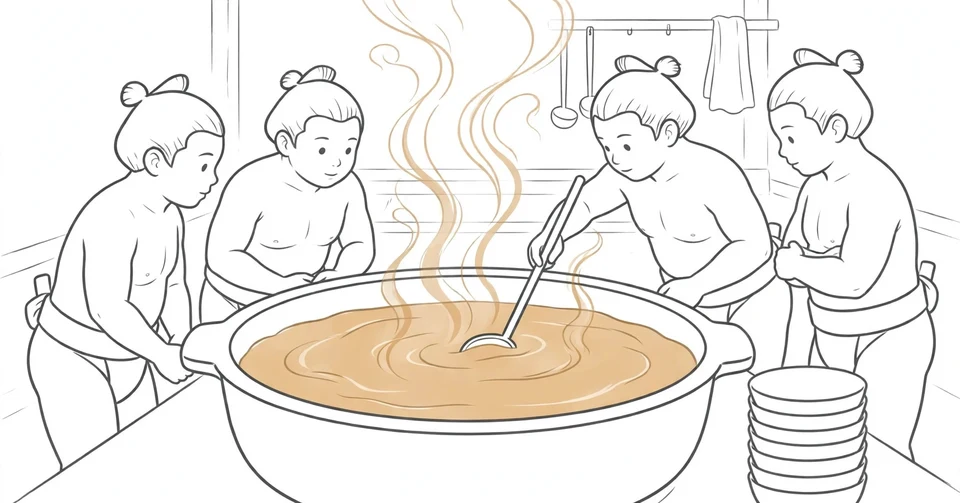
The kitchen runs on the same ladder. Cooking duty, the chankoban, rotates through the junior ranks. The team shops the day before, cooks under a senior low ranked wrestler known as the chanko-cho, a role so associated with experience that its holder is nicknamed grandpa, and produces the day's first meal after training ends around noon. That meal is usually chankonabe, the great communal hot pot that has become the symbol of stable food. A visit to the Takadagawa stable in Tokyo recorded the same shape of day seen across the sumo world, with the first meal of the day arriving only after a full morning of practice.
Even rest is distributed by rank. The sekitori bathe first, in clean water, and are served their food first. The juniors, who were awake before everyone else, bathe and eat last. Then the whole house takes the famous post lunch nap, and the heya goes quiet. Afternoons belong to cleaning the baths, laundry, drying the used loincloths, fan club business, and hobbies, before the day resets at dawn.
Joining at fifteen
Most recruits walk into a heya at about fifteen years old, straight out of junior high school, sometimes after a short trial period to see whether boy and house suit each other. Some arrive later, from high school or university amateur sumo, but the classic recruit is a teenager with a bag of clothes and a family's hopes. He will not earn a salary for years. Only the roughly seventy sekitori are paid wages by the association. Everyone below them receives food, lodging, training, and a small allowance, and in exchange gives the heya nearly all of his time and obedience.
The door is narrow in other ways too. Since 2002, each heya has been allowed only one foreign born wrestler, a rule meant to force assimilation into the stable's language and customs, and one that still draws criticism. Women, meanwhile, are excluded from the professional structure altogether, apart from the okamisan and the master's family inside their own apartment.
Finding boys willing to accept these terms has become the system's quiet crisis. Free food and housing once attracted plenty of apprentices, but today's fifteen year olds have easier options, and the low pay and hard hierarchy of the lower ranks discourage the rest. Stables have been closing and merging in recent years, and masters with good school and university connections recruit far more easily than those without. The heya system has survived for centuries, but it now depends on a supply of teenagers that modern Japan is less and less willing to send it.
Watching from the doorway
For all its closed reputation, the heya is not sealed. Many stables welcome visitors to watch morning practice free of charge, sitting quietly on the platform beside the ring. The rules vary from house to house. Some ask for advance notice, some require silence and no photography, and some ask foreign visitors to bring a Japanese speaker. The Sumo Association also runs an open stable programme that brings schoolchildren inside during the summer holidays.
The house even travels. For the three grand tournaments held outside Tokyo each year, a heya packs up and reconstitutes itself in shrine grounds or community halls in Osaka, Nagoya, or Fukuoka, and the married wrestlers who normally live at home move back into the dormitory with everyone else. For a few weeks, the whole portable village runs exactly as it does in Ryogoku.
Standing at the edge of a training room in the early morning, what stays with me is not the force of the wrestling. It is the domesticity wrapped around it. Boys who were throwing each other into the clay an hour ago are scrubbing baths, folding laundry, and ladling stew under the eye of a senior everyone calls grandpa. The violence is scheduled. The care is constant.
A hard system that is slowly softening
None of this should be romanticised too far. A system where men in their twenties hold near total authority over teenagers, inside a house with no real privacy and no exit that does not end a career, will produce discipline problems, and sumo has had them. The association's rules for stables are in some respects now stricter than the norms of the society outside, precisely because the old informality failed too visibly.
The response, characteristically, has been gradual rather than dramatic. Some stables now employ professional cooks or nutrition advisers so that juniors can spend more time training and less time in the kitchen. Some masters have taken sports related degrees before opening their houses. Many heya run YouTube channels, publish their daily life, and sign cooperation agreements with their local wards, presenting themselves as community centres rather than fortresses. The house is opening its windows without, so far, changing its floor plan.
To me, the heya survives because it answers a question modern sport prefers to outsource. Who actually raises the athlete? The heya's answer is total. It feeds him, houses him, teaches him manners, manages his money, comforts him at fifteen, and buries his career gently at the end. The price is equally total, measured in privacy, freedom, and years of unpaid work at the bottom of the ladder. Both halves of that bargain are real, and any honest account of the system has to hold them at the same time.
There is a reason wrestlers so often use the word home for the building they were ordered to live in. In their case it is not a metaphor or a piece of public relations. It is the literal address of their lives, the place that took them in as children and remade them. Nobody commutes to a heya, because everything a commute separates, work and rest, colleagues and family, ambition and belonging, the heya deliberately refuses to separate at all.
More in Culture & Society
Latest posts
- A Dried Shiitake Is Louder Than a Fresh One
- Loma Linda's Long Lives Run on Saturdays
- Maruten Numazu and the Towering Kakiage Bowl of the Port
- The Three Sisters Grow Better Together
- Tatamiishi Terraces Filter a River Through Stone
- Wasabi-Zuke Puts the Whole Plant in Sake Lees
- Konyoku Is Still Out There, Past the Last Train Station
- Dry January Lasts a Month on Purpose
- Ikaria Runs on Island Time
- Why Nicoya Cooks Its Corn in Lime
- Nobody Eats the Daidai, and That Is the Point
- There Are Only 105 Toshiyori Shares in All of Sumo
- Kasuzuke Pickles Almost Anything in Sake Lees
- The Usho Answers to the Imperial Household
- Every Heya Runs on an Okamisan