Urashima Taro, the Fisherman Who Visited the Dragon Palace
· 9 min read
Urashima Taro is the Japanese folk tale of a kind fisherman carried to the Dragon Palace, who came home to find 300 years gone and a box he should never have opened. This is the story as Japan tells it, the older legend behind it, and the shrine that still keeps his name.
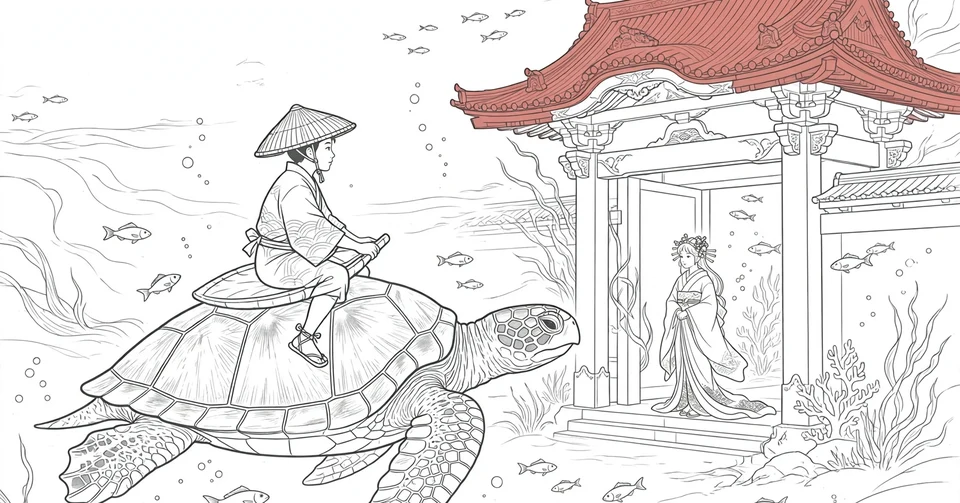
Ask almost anyone in Japan to name a folk tale, and Urashima Taro will be among the first they mention. It is the story of a kind young fisherman who rescues a sea turtle and is carried on its back to the Dragon Palace beneath the sea. He comes home carrying a beautiful box he must never open, and, of course, he opens it.
The tale of Urashima Taro has been told for well over a thousand years, and it survives because its wound is simple and permanent. The fisherman did almost nothing wrong. He was kind, and then he was homesick, and for that he lost three centuries.
Many people outside Japan have already met a piece of this story without knowing it. The princess who welcomes the fisherman under the sea is Otohime, daughter of the Dragon King, and she is the same princess whose name now sits on the Otohime sound device in Japanese restrooms. The fairy tale came first, and it is considerably sadder than the gadget.
The story of Urashima Taro, as Japan tells it
Long ago, in a fishing village, there lived a young fisherman named Urashima Taro. One day on the beach he found a group of children tormenting a sea turtle. He bought the turtle from them and released it into the sea.
A few days later, while Urashima Taro was out fishing as usual, the turtle returned. It thanked him, and offered to carry him on its back to Ryugujo, the Dragon Palace at the bottom of the sea. There the princess Otohime received him with gratitude, and the days passed in feasting and dancing among the creatures of the sea.
After a while, though, Urashima Taro grew homesick. He thought of his mother and father, and asked to go home. Otohime tried to persuade him to stay, but in the end she let him go, giving him a parting gift, a mysterious box called a tamatebako. There was one condition. He must never, ever open it.
When Urashima Taro returned to his village, everything had changed. His home was gone. His parents were dead, and nobody he knew remained. When he asked after himself, people said they had heard of a man called Urashima Taro who had vanished at sea long ago. Three hundred years had passed since he went down to the Dragon Palace.
Struck with grief, and perhaps forgetting the warning, Urashima Taro opened the box. A cloud of white smoke rose out of it and touched his face. In a moment his beard was long and white and his back was bent with age. From the sea came the sad, sweet voice of the princess: "I told you not to open that box. In it was your old age."
It is a strange reward for kindness, and children who hear the story early carry its unfairness with them for life. That, I think, is exactly why it lasts. Urashima Taro is not punished for cruelty or greed, the usual fairy tale crimes. He is punished by time itself, which does not negotiate.
A legend far older than the fairy tale
Urashima Taro was already old when Japan was young. A figure called Urashimako, also read as Urashima no ko or Ura no Shimako, appears in writing in the 8th century, in three of the oldest books the country has: the Fudoki of Tango Province, the Nihon Shoki, and the Man'yoshu, the great anthology of early poetry.
The Nihon Shoki, Japan's early chronicle, mentions him in an entry dated to the year 478. Urashimako of Mizunoe, it says, caught a turtle while fishing, and the turtle changed into a woman. Together they went into the sea and reached Mount Horai, the timeless land, where they saw immortals. There is no palace and no box yet, but the bones of the story are already there.
The Fudoki of Tango, a gazetteer of the province where the legend belongs, tells it more fully. There, Urashimako catches a five coloured turtle, which transforms while he sleeps into a woman from the household of immortals. After three years with her, he longs for his parents and home. She gives him a jeweled comb box, a tamakushige, and forbids him to open it if he ever wishes to return to her.
He comes home to find no trace of his family, and learns he would be over three hundred years old if he were still alive. Forgetting the promise, he opens the box. In this oldest version he does not grow old. Instead, a beautiful figure like a fragrant orchid is carried away with the clouds to the heavens, and he understands he can never meet the princess again. Strangely, touchingly, the two still manage to exchange poems. A poem reflecting on the legend also survives in the Man'yoshu, ascribed to the poet Takahashi no Mushimaro, and it already speaks of the woman's father as the Sea God.
Even the familiar name is younger than the tale. Urashimako became Urashima Taro much later, probably through the kyogen comic theatre, where Taro was a stock name for a young man.
How the story kept changing
Between the old legend and the modern children's book, almost every famous detail moved house. The destination was once Horai, the timeless land of the immortals, reached by boat. It only became the Dragon Palace, with Otohime installed as the Dragon King's daughter, in the otogi-zoshi, the illustrated storybooks of the Muromachi period. The most famous image of all, Urashima Taro riding on the turtle's back, is more recent still. It appears only in the early 18th century.
The amount of time he loses changes from telling to telling. The Fudoki and the modern version give him three hundred years. In the widely read Otogi Bunko storybook, seven hundred years have passed, and the box releases three wisps of purple cloud that age him. That version then turns gentle: Urashima Taro becomes a crane, his wife returns to the form of a turtle, and the two are worshipped as myojin, local gods.
The box itself will not sit still either. In a version collected in Kagawa by the folklorist Keigo Seki, it is a three tiered box. The first tier holds a crane's feather, the second a puff of white smoke that ages him, and the third a mirror, so that he can see his aged face for himself. The feather then fastens to his back, and he flies up to circle his mother's grave. Other endings are harsher or stranger. In one he falls to dust and dies. In another he grows gills, leaps back into the sea, and is young again. Scholars count more than fifty surviving otogi-zoshi texts of the tale, sorted into four families, as the detailed reference history of Urashima Taro lays out.
The single version most Japanese children now learn was settled by the storyteller Iwaya Sazanami in the Meiji period, and then carried into the national elementary school textbooks. That is the version told above, and its smoothness hides how wild the older family of stories really is.
The shrine that keeps his box
The legend has an address. On the western coast of the Tango Peninsula, outside the little fishing village of Ine in northern Kyoto, stands Urashima Jinja, the shrine of Urashima Taro.
The shrine keeps an old document that treats the voyage as sober history. In its account, Urashimako left his home in 478 and returned in 825, carrying a tamatebako. Ten days later he opened it, white smoke rose, and he became an old man. Later that same year, the document says, Emperor Junna ordered the courtier Ono no Takamura to build a shrine to commemorate the strange voyage, and to house the box and the spirit of Urashimako himself.
Whether any box rests there now is a question the shrine answers with its own quiet confidence. What is certain is that the place is alive. Kyoto's official travel guide notes that people still visit Urashima Shrine to pray for health, longevity, and good fishing at sea, which is a fitting set of requests to bring to a man who was given centuries and lost them all in an afternoon.
Why Japan never forgot him
Urashima Taro endured because Japan put him in front of every child. His story stood among the small set of tales in the national language readers, and a school song about him, first printed in 1911, is still widely known. Japan keeps a short shelf of stories that are absorbed almost before a child can read, and Urashima Taro stands on it alongside figures like Hachiko, the dog who waited nine years at a Tokyo station. Tales like these are loved less for their plots than for the feeling they leave behind.
His afterlife kept growing. An animated film of Urashima Taro, made in 1918, is counted among the oldest anime created in Japan. The writer Osamu Dazai retold the story of Urashima Taro at length in 1945, using it as a platform for his own reflections. And his name has escaped the story altogether. Physicists use the term Urashima effect as another name for time dilation, the effect by which a traveller comes home having aged far less than everyone who stayed behind, which is almost exactly what happened to the fisherman, grief included.
Every culture keeps a story about coming home too late. Japan's is gentle on the surface and absolute underneath. The box was never really a trap, and Otohime was never really cruel. The box was simply his three hundred years, kept safe for him under the sea, waiting politely to be claimed the moment he came back to claim his life.
More in Culture & Society
- The Tengger Carry Their Dead Out of the Village in Entas-Entas
- Urashima Opened the Tamatebako and Time Came to Collect
- How Supersemar Borrowed the Authority of a God
- Bali Has Its Own Semar, and His Name Is Twalen
- White Silk Means You Made It as a Sekitori
- The Dohyo-Iri Gives a Yokozuna Three Minutes to Own the Ring
Latest posts
- Sober Curious Is Not Quitting, It Is Choosing
- Real Wasabi Refuses to Grow Almost Anywhere
- There Is Miso in Far More Than the Soup
- A Glass of Cannonau a Day in the Sardinian Hills
- A Rotenburo Is a Bath With Weather
- Katsuobushi Is a Fish You Shave Like a Block of Wood
- Nobody Commutes to a Heya
- Why Kagami Mochi Is Never Cut With a Knife
- Narazuke Pickles Spend Years Asleep in Sake Lees
- Tokyo Keeps a Hundred Tiny Fujis Called Fujizuka
- Tomozuri Sends a Living Fish to Do the Fishing
- One Thousand Three Hundred Years of Ukai Nights on the Nagara River
- Fuji Ko, the Pilgrim Societies That Climbed Mount Fuji Together
- Dashi, the Quiet Stock Under Almost Everything Japan Cooks
- Ayu, the Sweetfish That Rules Japan's Clear Rivers