Tawur Kesanga Settles the Demons Before Nyepi Begins
· 15 min read
Tawur kesanga is the great offering Bali makes on the eve of Nyepi, paying the bhuta kala at the crossroads so the island can enter its day of silence with nothing left unpaid.
Once a year, Bali spends a whole day and a whole night paying its debts to the unseen world, and only then does it dare to go quiet. The payment is called tawur kesanga, and it is the loudest, busiest, most crowded ritual in the Balinese calendar. It happens on the last day of the old Saka year, the day before Nyepi, and it is the reason the silence that follows feels earned rather than imposed.
The logic is simple enough to state and hard enough to live by. The island believes the world is full of bhuta kala, restless forces that disturb the balance of life when they go hungry or ignored. Tawur kesanga does not try to destroy them. It feeds them, honours them, and settles them back into their proper place, so that when the new year opens in total silence the next morning, there is nothing left unpaid to disturb it.
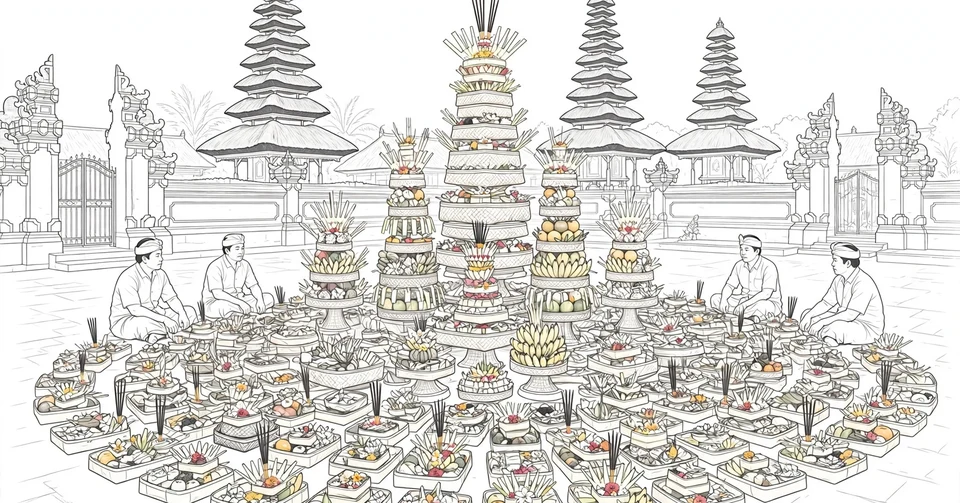
Tawur kesanga is not a festival in the ordinary sense. There are no tickets, no stage, and no audience in the way a visitor might expect one. It is a piece of work the whole island does together, and the work is spread across three levels at once: the great temple, the village crossroads, and the family home. The same ritual is performed at all three, scaled to fit the place, and the meaning stays the same at every scale. Something restless is fed, and the world is rebalanced.
What tawur kesanga actually is
Tawur kesanga falls on Tilem Sasih Kesanga, the dark moon of the ninth month of the Balinese Saka calendar. That day is the last day of the old Saka year, and the next morning, at six o'clock, the new year begins with Nyepi, the day of silence. The Saka era itself is counted from 78 CE, so the ceremony sits at the hinge of a calendar that has been turning for nearly two thousand years. Tawur kesanga is the hinge. It closes one year by settling its debts before the next one is allowed to open.
The ritual belongs to a family of rites known as Bhuta Yajna, offerings made to the bhuta kala. Its purpose is stated plainly in the tradition: to vanquish negative elements, to create balance between God, humankind and nature, and to appease Batara Kala, the lord of time and fate. The underlying idea has a name of its own, nyomya butakala, which means pacifying the demons rather than destroying them. That distinction matters, because it is the whole philosophy of tawur kesanga in a single word. The forces are not enemies to be beaten. They are neighbours to be settled with.
This is why tawur kesanga is best understood as a negotiation, not a battle. The bhuta kala are not imagined as an invading army. They are the rough, hungry side of the world itself, the part of the cosmos that eats and disrupts and decays. A world without them would be a world without appetite, and the Balinese do not pretend such a world exists. Instead, tawur kesanga gives them their due, on schedule, in public, and at the right place. A fed neighbour is a quiet neighbour, and the ceremony is the island's way of making sure the neighbours are fed before the year turns.
Tawur means payment
The word itself is worth pausing on, because it says more than any description of the ritual can. Tawur literally means payment. The ceremony is not a gift, a tribute, or a bribe. It is a settlement of accounts. The bhuta kala are owed something, and tawur kesanga pays it in full, in the open, where everyone can see the debt being cleared.
The payment is made in caru, the offerings laid on the ground for the bhuta kala, and the scale of the payment rises with the scale of the occasion. A daily offering at a doorway may be no more than two pinches of rice. A village tawur kesanga is a much larger affair, and the ladder of offerings climbs through chickens of five colours and directions, and then through specially coloured dogs, white ducks and geese. At the top of the ladder stands the greatest tawur kesanga of all, held every year before Nyepi at Pura Besakih, the mother temple on the slopes of Mount Agung, where the offerings run from chickens up through a goat, a cow, a black pig and a water buffalo.
That scale is not decoration. It is the point. The size of the payment is the measure of how seriously the island takes the debt, and the largest payment of the year is made at the largest temple on the island, on the last day of the year, for the whole of Bali at once. The belief that runs underneath it is that the animals offered are not simply destroyed. They are believed to rise in their next life, lifted by their part in the rite. Tawur kesanga is written here as belief, because that is what it is, and the belief is what makes the payment intelligible. Nothing in the ceremony is wasted. Everything offered is understood to go somewhere.
I find the honesty of that word hard to admire without also feeling a little exposed by it. Most of us prefer to call our settlements by softer names. We call them traditions, or gestures, or customs, and we let the vagueness do the work of excusing us. Tawur kesanga refuses the vagueness. It calls the thing a payment, and then it pays. There is something bracing about a culture that names its debts plainly and clears them in public before the year is allowed to begin.
The three days that make a new year
Tawur kesanga is the middle act of a three day sequence, and it only makes full sense inside that arc. The sequence begins with Melasti, held three or four days before Nyepi, when villages carry their sacred objects, the pratima, arca and pralingga, down to the sea or a lake to be washed, and fetch back the holy water called tirta amerta. First the world is cleansed. Then, on the eve of Nyepi, tawur kesanga pays the restless forces and settles them. Only then comes Nyepi itself, the day of silence, when the island stops for twenty four hours, from six in the morning until six the following morning.
Nyepi is kept under four vows, the Catur Brata Penyepian: no fire or light, no work, no travel, and no revelry or entertainment. The airport closes for the entire day, the roads empty, and the only people outdoors are the pecalang, the traditional village guards who patrol the streets to make sure the prohibitions are kept. Everyone else, Balinese Hindu or visiting tourist, stays inside and keeps the lights off. The day after Nyepi is Ngembak Geni, the relighting of the fire, when families gather again, ask forgiveness of one another, and cook and light their lamps once more.
The arc is what gives tawur kesanga its weight. Melasti washes the sacred things. Tawur kesanga pays the restless things. Nyepi stops everything, so that the clean and settled world can be listened to in silence. Take the middle act away and the sequence loses its logic. A silence that follows no payment is only a pause. A silence that follows tawur kesanga is a settlement, and the island enters it knowing the books are closed.
The timing of Nyepi itself follows the Saka calendar rather than the Gregorian one, so it usually falls in March, on a different date each year. That is worth saying plainly, because visitors who plan around a fixed date will be disappointed. The ceremony arrives when the moon says it arrives, and the island rearranges itself around that fact. Tawur kesanga is fixed to the same moon, the dark moon of the ninth month, and it cannot be moved to suit a calendar on a wall.
Where the payment is made
Tawur kesanga is performed at three levels, and the geography of each level is part of its meaning. At the village level the ceremony often takes place at intersections or crossroads, which are understood as sacred spaces inhabited by the bhuta kala. A crossroads is where paths meet and where things arrive from all directions, and that is exactly where a restless force would be found. The payment is made where the recipients already live.
The timing is chosen with the same care. The ceremony is held during the transition from morning to afternoon or the other way around, because those in between hours are believed to coincide with the roaming of the bhuta kala. Tawur kesanga meets its recipients at the hour when they are out, at the place where they gather, and pays them there. There is a practical wisdom in that, quite apart from the theology. A debt is best settled where the creditor can be found, and the ceremony goes to the crossroads instead of waiting for the debt to come knocking at the gate.
At home, the rite narrows to the family compound, and its culmination is the pengerupukan, the noisy sweeping out of the house. Families circle their homes carrying torches of dried coconut leaves, beating bamboo slit drums called kentungan or kulkul, banging pots and pans, and sweeping every corner, so that no dark place is left unvisited. The noise is the point. After the payment has been made, the house is swept clean of whatever the payment did not settle, and the family goes into the new year with a house that has been both paid for and cleaned out.
At the temple level the scale rises again, and the offerings become tiered towers of palm leaf, flowers, rice and fruit, spread across the courtyard in rows, with priests seated among them chanting the mantras that carry the payment to its recipients. The largest of these, at Pura Besakih, draws the whole island's attention, because it is the tawur kesanga performed for Bali as a whole rather than for one village or one family. The mother temple pays on behalf of everyone, and everyone else pays at home, and the two payments together cover the island from the mountain to the sea.
The monsters get their parade
As dusk falls on the day of tawur kesanga, the ritual changes key. The ogoh ogoh come out. These are the giant demonic effigies built over months by village youth from bamboo, papier mache, cloth and tinsel, some of them several metres tall, each one a face for the negative forces the ceremony has been settling all day. They are carried through the streets on the shoulders of a dozen or more young men, and at every junction the bearers stop and spin the figure around, dancing it in circles to drive the negativity out of that place before moving on.
The parade is the most famous part of the whole sequence, and it is easy to mistake it for the ceremony itself. It is not. The ogoh ogoh are the visible half of tawur kesanga, the part that can be photographed, and they do the work of showing the island what it is afraid of. Whatever a village fears or dislikes about itself, greed, anger, envy, arrogance, is loaded onto the platform, shown to everyone, and then, at the end of the procession, the effigies are usually burned, most often at the cemetery fields. The negativity is not denied. It is displayed first, and only then let go.
The burning is the hinge inside the hinge. Tawur kesanga pays the bhuta kala, and the ogoh ogoh gives the payment a body to look at. Then the body is burned, and the year can begin. Some figures escape the fire and are displayed in front of community halls for a month or more, and some are even purchased by museums and collectors, but the usual end is the flame, and the crowd that watches the burning knows what it is watching. It is the island's fears, made visible for one night, and then deliberately destroyed.
The parade is also the part of the ceremony most exposed to the world outside the temple, and that exposure has consequences. In 2024 the parades were cancelled in many places because a general election fell close to the festival and the regional government feared the parades might be used to carry political messages. Only villages, in particular traditional ones, were allowed to hold them. The episode is a useful reminder that tawur kesanga is not a show put on for visitors. It is a working ritual, and when the work and the spectacle pull in different directions, the work is what the island protects.
The argument about whether the parade belongs
Not everyone in Bali is comfortable with the parade, and the argument is worth reporting, because it shows how seriously the island takes the ceremony. The respected priest Ida Pedanda Gede Made Gunung argued that parading the figures after tawur kesanga was a misconception, since the offerings have already pacified the bhuta kala, and there is nothing left to drive away. Others note that the parade has no basis in scripture and exists simply to enliven the ritual. The ceremonies of Nyepi, they say, stand complete without it.
That objection is not a fringe view. It comes from inside the tradition, from a priest who knows the rites better than any visitor ever will, and it deserves to be heard on its own terms. If tawur kesanga has already settled the forces, then a parade that chases them away again looks like a contradiction. The payment has been made. Why shout at the creditor after the debt is cleared?
The answer the villages give, in practice if not in words, is that the parade does a different kind of work. Tawur kesanga settles the bhuta kala. The ogoh ogoh settles the people. A village that has built a monster together for weeks, carried it together through the streets, and burned it together at the cemetery has done something to itself that no offering alone can do. It has looked at its own greed and anger in the face, in public, and agreed to let them go. The priest is right about the theology, and the villages are right about the people, and tawur kesanga is large enough to hold both truths at once.
I think that is the honest way to read the disagreement. A ritual that has lasted for centuries does not survive by being tidy. It survives by being big enough to contain its own critics, and tawur kesanga contains this one gracefully. The payment is made in the morning and the parade marches at night, and nobody in the village seems confused about which is which.
Why the silence needs a payment first
There is a temptation, for a visitor, to treat Nyepi as the whole story and tawur kesanga as the warm up act. The silence is so striking, so unlike anything else on earth, that it swallows the attention. An entire island, dark and still for a full day, is a spectacle in its own right, and it is easy to fly in for the silence and fly out again believing you have seen Bali at its most profound.
That would be a mistake, and tawur kesanga is the reason why. The silence of Nyepi is not profound because it is silent. It is profound because it is paid for. The island does not simply stop. It cleans itself, pays its debts, sweeps its houses, burns its fears, and then stops, knowing there is nothing left outstanding to disturb the quiet. The silence is the receipt, not the purchase. Tawur kesanga is the purchase, made in daylight, at the crossroads, in front of everyone, so that the night can be still without anything hiding in it.
That order, payment first and silence second, is the most useful thing Bali has to teach anyone who will listen. We are good at demanding quiet from our lives and our neighbours, and we are much less good at settling the things that make quiet impossible. We want the peace without the payment, the clean slate without the scrubbing, the new year without the accounting. Tawur kesanga says the order matters, and it says it with a whole island behind it. First the world is washed, then its restless forces are paid in full, and only then does the island allow itself a day of silence. The silence is not an escape from the work. It is what the work earns, and the work is what makes the silence honest.
More in Culture & Society
- Suka Duka Means the Banjar Shows Up for Joy and Grief Alike
- Tabuh Rah Spills Blood So the Ground Stays Calm
- The Bendesa Adat Speaks for a Village That Has Two Governments
- Catur Brata Is Four Silences Kept at the Same Time
- Your Weton Is the Day You Were Born, Counted Two Ways
- Rahu and Ketu Still Chase the Sun and Moon Across the Sky
Latest posts
- On Koyasan the Founder Is Said to Be Still Meditating
- Hiwatari Asks You to Walk Across the Fire
- Ngembak Geni Is the Morning Bali Starts Talking Again
- Karang Ayahan Is the Plot of Land a Village Trusts You With
- On Tumpek Landep Bali Blesses Everything Made of Metal
- Sudachi Is the Sharpest of Japan's Sour Citrus
- Shugendo Turns a Mountain Into a Place of Testing
- A Canang Sari Is Made Fresh Every Morning and Gone by Night
- The Aling-Aling Wall Exists Because Spirits Walk in Straight Lines
- Oi-Nishin Sent Tohoku Farmers Chasing Herring Every Spring
- The Nishin Goten Were Palaces Paid for by Fish
- The Tobi Were Edo's Daredevils Before They Were Its Firemen
- Kabosu Is Oita's Gentle Answer to Yuzu
- A Yamabushi Trains Where the Mountain Is the Temple
- Tri Hita Karana Holds a Village in Three Balances