Tokyo Keeps a Hundred Tiny Fujis Called Fujizuka
· 11 min read
Hidden in Tokyo shrine grounds stand fujizuka, miniature Mount Fujis of dark lava rock built by Edo pilgrim societies so that anyone could make the sacred climb. About 60 survive, and a few still open for climbing when the real season begins.
Tokyo hides its mountains in plain sight. Behind the gate of a neighbourhood shrine, past the purification basin and the prayer hall, there often stands a small steep hill of dark volcanic rock, rarely taller than a house. These hills are fujizuka, miniature versions of Mount Fuji built by hand in the Edo period, and climbing one was understood to bring much the same blessing as climbing the real mountain, all 3,776 metres of it.
The builders were the fuji ko, the pilgrim societies devoted to Mount Fuji. Members pooled their money through the year so that a few chosen representatives could climb the sacred peak each summer. Everyone else, the elderly, the frail, small children, and women, who were barred from the summit of Fuji altogether, received a mountain of their own at the end of their street.
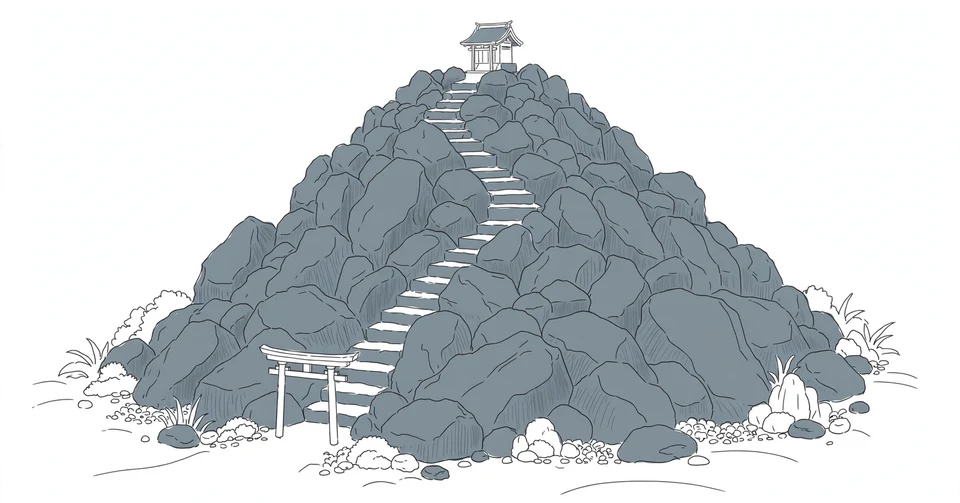
At the height of the movement, Edo may have held as many as 800 of these little mountains. Around 60 fujizuka survive in and around Tokyo today, some protected as cultural properties, others half forgotten behind apartment blocks. A handful still open their narrow paths for a few days each year, on the same mornings when the climbing season begins on the real Fuji, far to the southwest.
Why Edo built its own fujizuka
For most of Japanese history, climbing Mount Fuji was the business of mountain ascetics, followers of Shugendo who treated the peak as a place of severe spiritual training. Ordinary townspeople admired the mountain from a distance, painted it, printed it, and prayed toward it, but they did not climb it. That changed in the Edo period, when the teachings of Hasegawa Kakugyo, a Fuji devotee who lived from 1541 to 1646, spread among the common people of the shogun's capital.
Kakugyo's followers organised themselves into confraternities called fuji ko, grouped by neighbourhood and by trade. I wrote about their world in my article on the fuji ko, the pilgrim societies that climbed Mount Fuji together. The groups met through the year, collected dues, and treated the summer ascent as the shared project of the whole community. The fuji ko were so influential that features every modern climber takes for granted, the ten stations on the trails and the walking circuit around the crater, were shaped by their habits.
The problem was simple arithmetic. The journey from Edo to Fuji took days on foot each way and cost more than most households could spare. Only hardy young men usually made the trip as the group's representatives. Women were excluded from the sacred summit by religious rule, a ban that lasted until the early Meiji period. Children and the old could not manage the climb at all. A faith that revolved around one mountain was, in practice, closed to most of the faithful.
The fujizuka were the confraternities' answer. If the members could not all go to the mountain, the mountain would come to the members, rebuilt at walking scale as a fujizuka in the grounds of the local shrine. Climbing the replica with the right prayers was held to count, in spiritual terms, as climbing Fuji itself. It was a practical solution, but I think it was also a generous one, an insistence that devotion should not depend on money, health, age, or sex.
The first fujizuka took nine years to build
Credit for the first fujizuka usually goes to Takada Toshiro, the leader of a local fuji ko branch. In 1780 his group began building a fujizuka, a miniature Fuji, on shrine ground, hauling volcanic rock and soil all the way from the real mountain so that the replica would quite literally be made of Fuji. The finished mound stood about ten metres high, and it is said to have taken more than nine years to complete. Its slopes carried copies of the station markers, small shrines, and stone monuments of the real climb.
The Takada Fuji, as everyone called it, became a popular attraction in its own right, busy with worshippers and the simply curious. It still exists. In 1963, when Waseda University expanded its campus, the mound was moved into the nearby grounds of Mizuinari Shrine, where it now sits quietly among the trees a short walk from the students it predates by two centuries.
Once the idea had been proven, it spread quickly. Two celebrated mounds rose in Meguro, the Moto-Fuji in 1812 and the Shin-Fuji in 1819, and both were famous enough for the artist Hiroshige to include them in his series One Hundred Famous Views of Edo. Both were later cleared away as the modern city grew. Many more fujizuka followed the same pattern, and Japan Today's account of the surviving mounds puts the total in the city at around 800 by the early nineteenth century, when Fuji worship was at its peak. Among them, a celebrated set known as the seven Fujis of Edo held the highest prestige, though writers admit the choice of exactly seven was always somewhat arbitrary.
Built like the real mountain, only smaller
A fujizuka was never just a pile of earth. Builders heaped up local soil and stone for the body of the mound, then dressed its surface with a skin of rust coloured volcanic rock brought from Mount Fuji itself, so that the little mountain looked, and in a sense was, made of the same material as the original. A steep path wound up the slope, passing stone markers for the ten stations, so that a climb of a few minutes repeated the shape of an ascent of two days.
At the top stood a small Sengen shrine, a scale copy of the shrine on Fuji's summit, dedicated to the goddess of the mountain. Most fujizuka were affiliated with Sengen shrines, under the head shrine of Fuji worship, Fujisan Hongu Sengen Jinja at the mountain's foot. Some fujizuka reproduced even the details of the summit, a rim suggesting the crater, or copies of the Otainai lava caves, where expectant mothers on the real mountain prayed for a safe birth. Others took a shortcut offered by the landscape itself. At Komagome and Jujo, builders raised their mini Fujis on top of ancient burial mounds that were already the right shape.
Sizes varied widely. A typical fujizuka stood only about three metres high, but the famous ones were far grander. The mound behind Narukotenjinsha in Shinjuku, built as late as 1920, rises twelve metres and is now thoroughly dwarfed by the office towers around it. The point was never the height. The point was that every feature of the sacred original had been thought about, copied, and made climbable by anyone in the parish.
Fujizuka you can still climb today
The best place to understand what a fujizuka meant is the Shitaya Sakamoto Fuji in Taito City, in the old downtown of Tokyo. A confraternity called the Azuma ko built it in 1828 on the grounds of Onoterusaki Shrine. It is five metres high and sixteen metres across, with a stone marker for the eighth station on its slope and statues of En no Gyoja, the founder of mountain asceticism, at its foot. The fujizuka is designated a national Important Tangible Folk Cultural Property, and precisely because it is so well preserved, it stays locked for almost the whole year.
Sendagaya offers an easier encounter. The fujizuka at Hatonomori Hachiman Shrine, a short walk from the National Stadium, was built in 1789 and is often described as the oldest fujizuka in Tokyo. It stands about six metres high, is protected as a tangible folk cultural property of the capital, and, unlike Sakamoto, it can be climbed all year round. The ascent takes about a minute, past small stone shrines on the winding path, to a summit crowned with genuine Fuji lava rock.
In Nerima, the Ekoda no Fuji rises behind the hall of Ekoda Sengen Shrine. At about eight metres it is one of the taller survivors, and its small stone summit shrine dates from 1839. Like Sakamoto, it opens for climbing only on a few set days a year. The Toshima Nagasaki Fuji, in the grounds of Takamatsu Sengen Shrine, is said to keep the most original shape of all, eight metres high and twenty one metres across, its slopes watched over by some fifty Buddhist statues. Nippon.com's guide to Tokyo's little Mount Fujis counts more than sixty surviving fujizuka in and around the capital, most of them still climbable at least occasionally, and even lists a few outside the city, such as the Kizoro Fuji of 1800 in Kawaguchi, Saitama.
When the little mountains open for yamabiraki
The most important date in the fujizuka calendar is yamabiraki, the ceremonial opening of the climbing season on the real Mount Fuji, in late June and early July. For a few days around that date, the gates of the protected fujizuka are unlocked. At Shitaya Sakamoto, the one time of year when anyone may climb is 30 June and 1 July, and neighbours queue in the summer heat to make an ascent that takes less time than the wait.
The contrast with the original could hardly be sharper. The modern climb, as I described in climbing Mount Fuji, Japan's sacred peak, now involves entry fees, checkpoint gates, and thousands of fellow climbers sharing a two month season. On a fujizuka there is no fee, no queue worth the name, and no view of anything except the shrine garden and the rooftops. What there is, instead, is continuity. The fuji ko themselves disappeared long ago, but the mounds they built still anchor neighbourhood festivals, and for a few mornings each summer the old bargain is honoured again. Anyone may climb, and the climbing counts.
There is something quietly funny about a sacred mountain you can summit before your coffee cools, and the people who open the gates seem to enjoy the joke as much as the ritual. But the humour should not hide the seriousness underneath. These openings are acts of maintenance, of faith and of memory at once, keeping both the fujizuka and its meaning from crumbling away.
What survived, and what did not
Most of Edo's little mountains are gone. Through the twentieth century they were demolished for roads and buildings, burned in fires, shaken down or bombed in the war, and occasionally nibbled away by builders who treated them as convenient piles of rubble. When people finally began counting and protecting what remained, only about sixty fujizuka were left in and around the capital. Designation as cultural properties, national and local, slowed the losses, and the mounds began to be treated as heritage rather than as leftover dirt.
Interest revived after Mount Fuji joined the World Heritage list in 2013. Communities started restoring local fujizuka that had fallen into neglect. In 2015 the city of Fuji began an archaeological dig at the Suzukawa Fuji, the only fujizuka left in Shizuoka Prefecture. A year later, volunteers in Shiki, Saitama, rebuilt the steps of the Tagoyama Fuji and opened it to climbers for the first time in thirty years. Entirely new fujizuka still appear from time to time, such as the modest Fuji, a metre and a half high, that arrived in Asakusa in 2016, though these are built more for visitors than for worshippers.
Living in Shizuoka, I see the real mountain often, and I do not think the replicas compete with it. They were never meant to. They are a record of what ordinary people did when the sacred was out of reach, they built a smaller version and opened it to everyone. A five metre heap of lava rock behind a shrine may be the most democratic monument in Tokyo.
The real Fuji will always belong to the climbers who queue on its slopes each summer. The little ones belong to the city itself, to anyone who turns into a quiet shrine garden and finds a mountain waiting there. Tokyo kept its tiny Fujis because their builders understood something worth keeping. A mountain does not have to be tall to be worth climbing, as long as the climbing is done in earnest.
More in Culture & Society
Latest posts
- A Dried Shiitake Is Louder Than a Fresh One
- Loma Linda's Long Lives Run on Saturdays
- Maruten Numazu and the Towering Kakiage Bowl of the Port
- The Three Sisters Grow Better Together
- Tatamiishi Terraces Filter a River Through Stone
- Wasabi-Zuke Puts the Whole Plant in Sake Lees
- Konyoku Is Still Out There, Past the Last Train Station
- Dry January Lasts a Month on Purpose
- Ikaria Runs on Island Time
- Why Nicoya Cooks Its Corn in Lime
- Nobody Eats the Daidai, and That Is the Point
- There Are Only 105 Toshiyori Shares in All of Sumo
- Kasuzuke Pickles Almost Anything in Sake Lees
- The Usho Answers to the Imperial Household
- Every Heya Runs on an Okamisan