The Krakatoa Eruption, Heard Around the World
· 9 min read
The Krakatoa eruption of 1883 was one of the loudest sounds in recorded history, a blast heard thousands of miles away that killed more than 36,000 people and coloured sunsets around the world.
On the morning of 27 August 1883, an island between Java and Sumatra blew itself apart. The Krakatoa eruption was so loud that people in Perth, Australia, almost 2,000 miles away, heard it and thought it was cannon fire. It remains the loudest sound in recorded history.
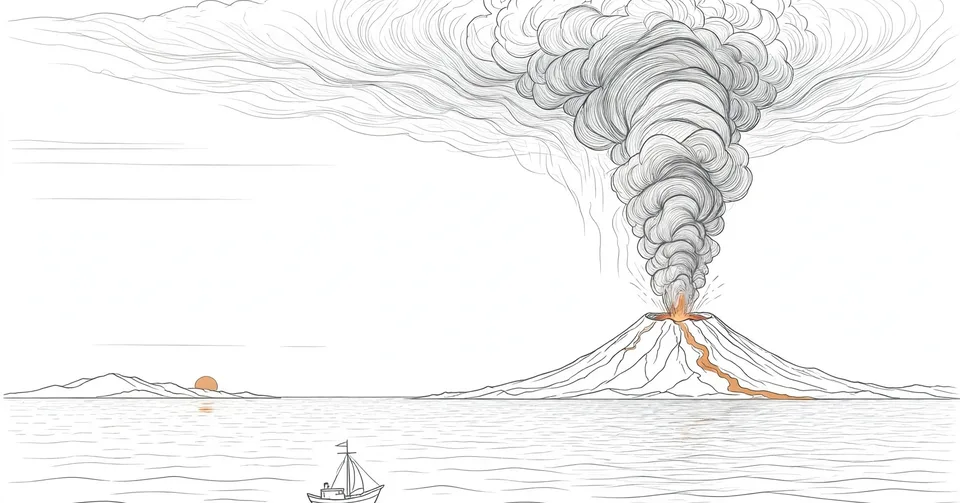
But the noise was the smallest part of the story. The Krakatoa eruption killed more than 36,000 people, most of them drowned by the waves it threw across the Sunda Strait. It cooled the planet, painted sunsets red on the far side of the world, and left behind an empty sea where an island used to stand. Then, from that same sea, a new volcano began to grow, and it is still growing today.
What the Krakatoa eruption was
Krakatoa, known in Indonesian as Krakatau, was a small volcanic island in the Sunda Strait, the narrow sea between Java and Sumatra. It sat on the same restless volcanic arc as the rest of Indonesia, a chain of fire that runs the length of the archipelago. The volcano had been rumbling since May 1883, throwing up ash and small explosions, and people on the coasts of Java and Sumatra could hear it grumbling for months.
The climax came on 26 and 27 August. After a day of growing explosions, the island erupted in a series of blasts so violent that two thirds of the island collapsed into the sea. The largest explosion, at around 10 in the morning on 27 August, released energy estimated at hundreds of times the force of the atomic bomb dropped on Hiroshima. It was, by most measures, the most powerful volcanic explosion of the modern era, second only to the eruption of Mount Tambora in 1815, which carried several times its energy and changed the climate of the whole world.
Indonesia has lived with this kind of danger for centuries. The same arc that produced the Krakatoa eruption also produced Mount Bromo in East Java, a volcano you can still walk up to and look into today. The difference is scale. Bromo rumbles and smokes. Krakatoa tore itself apart.
The sound heard around the world
The most famous fact about the Krakatoa eruption is its sound. The main explosion was heard in Perth, Australia, about 1,930 miles away, where people thought they heard distant guns. It was heard on Rodrigues Island in the Indian Ocean, about 3,000 miles away, where the islanders thought it was a ship firing distress signals. No sound made by nature or by humans has ever been recorded travelling so far.
The blast did more than make noise. It sent a pressure wave around the planet, and barometers in Europe and America recorded the wave passing, circling the Earth, and passing again. Instruments picked it up as many as seven times over five days. The air itself rang like a bell, and the whole world could measure it.
People who study sound still use the Krakatoa eruption as the reference point for the loudest possible noise. The explosion was so strong that it is believed to have reached about 310 decibels at its source. That is far beyond the threshold where sound stops behaving like sound and becomes a shock wave. Anyone close to the island would not have heard a bang. They would have felt the air itself tear.
The waves that did the killing
For all its noise, the Krakatoa eruption killed mostly in silence, by water. When the island collapsed into the sea, it pushed up waves that raced across the Sunda Strait in every direction. In places the waves reached more than 30 metres high, higher than a ten-storey building, and they struck the coasts of Java and Sumatra with almost no warning.
Coastal towns were wiped out. The Krakatoa eruption had struck with almost no warning, and there was nowhere to run. The town of Anjer, now spelled Anyer, was destroyed, and its lighthouse was carried inland. Ships were lifted out of the water and dropped on dry land. A Dutch warship, the Berouw, was carried nearly two miles inland and left sitting in the jungle. More than 36,000 people died, and the great majority of them drowned in the tsunamis, not in the explosion.
The waves did not stop at the strait. They were recorded on tide gauges as far away as the English Channel, more than 11,000 miles from Krakatoa. The sea itself carried the news of the Krakatoa eruption around the world before the telegraph cables did, because the undersea cables in the strait had been cut by the blast.
The year the sunsets turned red
The Krakatoa eruption threw an enormous column of ash and gas into the stratosphere, the high layer of the atmosphere where dust can stay aloft for years. Fine particles of sulphur turned into a thin veil that spread around the planet, dimming the sun and cooling the Earth. Average global temperatures fell by around a degree Celsius in the year after the eruption, and the weather in many countries turned strange, with cold summers and heavy rain.
The most visible effect was in the sky. For months after the Krakatoa eruption, sunsets around the world burned a deep, blood red. People in London, New York and Sydney wrote about skies they had never seen before, and painters tried to capture them. Every red sunset that winter was a reminder of the Krakatoa eruption, written across the sky in ash. Some researchers have suggested that the red sky in Edvard Munch's The Scream, painted a decade later in Norway, was inspired by the Krakatoa sunsets Munch had seen in the 1880s. The idea is still debated, but the sunsets themselves are not. They were real, they were worldwide, and they were the ash of a small Indonesian island, hanging in the air above every continent.
The sky stayed strange for more than a year. The veil of dust circled the globe and slowly settled, and as it did, the world returned to normal. But the Krakatoa eruption had shown, for the first time in the age of the telegraph and the barometer, that a single volcano could change the weather of the entire planet, and that everyone on Earth could measure it happening.
The child of Krakatoa
Krakatoa itself was mostly gone. Where the island had stood, there was open sea, and the map of the Sunda Strait had to be redrawn. But the volcano underneath was not dead. In 1927, a new cone began to rise from the sea at the same spot, and it was named Anak Krakatau, the Child of Krakatoa.
Anak Krakatau has been growing ever since, rising a few metres every year as lava and ash pile up. It is one of the most closely watched volcanoes in Indonesia, because it is young, steep, and unstable. In December 2018, part of its flank collapsed into the sea during an eruption, and the tsunami that followed killed more than 400 people along the coasts of Java and Sumatra. The Krakatoa eruption of 1883 and the tsunami of 2018 are now studied together, as two chapters of the same volcano. The child of Krakatoa had shown that it could kill too, and that the story of the Krakatoa eruption was not finished.
Scientists now monitor Anak Krakatau day and night, with sensors on the island and satellites overhead. The volcano is expected to keep growing, and another large collapse is possible, though nobody can say when. The lesson of 1883 is that the danger is real, and the lesson of 2018 is that it is still present.
Visiting the Krakatau islands today
The Krakatau islands can be visited by boat from the towns of Anyer or Carita on the west coast of Java. The trip takes about two hours each way, and most visitors go for the day, walking on the black sand beaches of the old island and looking across the water at Anak Krakatau, which still steams and smokes.
| Stop on a Krakatau trip | What you will see |
|---|---|
| Rakata, the old island | Black sand, the steep cliff left by the 1883 collapse |
| Anak Krakatau | The young volcano, still growing, off limits to climb |
| The strait itself | Open sea where the island of Krakatoa once stood |
Landing on Anak Krakatau itself is not allowed, and the boats keep a safe distance, because the volcano is active and the exclusion zone changes with its mood. Every stop on the trip is a piece of the Krakatoa eruption story, from the cliff the blast left behind to the volcano that grew in its place. The visit is not a climb, the way a trip to Mount Bromo is, with its 250 steps to the crater rim. It is a boat ride around a place that no longer exists, looking at the volcano that replaced it.
The best time to go is the dry season, roughly from April to October, when the sea is calm. The boats leave early in the morning, and the whole trip takes a full day. It is a long way from Jakarta, about three hours by road to the coast, and the sea can be rough outside the dry season, so most people go with a local tour.
Why the Krakatoa eruption still matters
The Krakatoa eruption matters because it was the first natural disaster the whole world watched happen in something close to real time. Telegraph cables carried the news within hours. Barometers on every continent recorded the pressure wave. Tide gauges measured the waves. Scientists collected ash, studied the sunsets, and worked out, for the first time, how a single volcano could cool the planet. The eruption turned volcanology from a local curiosity into a global science.
It also matters because the volcano is still there, in a new form, in one of the busiest sea lanes in the world. The Sunda Strait is crossed every day by ships, and its coasts are home to millions of people. Anak Krakatau is a reminder that the ground under Indonesia is alive, and that an island can disappear in a morning.
The loudest sound in history came from a small island that most of the world had never heard of, and it was heard on the far side of the planet. The Krakatoa eruption is history, but Anak Krakatau is the present. That is worth remembering the next time the ground rumbles in the Sunda Strait, because the sea keeps the memory, and the child of Krakatoa keeps growing.
More in Culture & Society
- Bonenkai, Japan's Year-End Parties Where the Year Gets Forgotten
- The 9060 Problem, When Parents in Their 90s Still Carry Children in Their 60s
- The Dalang, the Single Voice Behind Every Wayang Puppet
- Yadnya Kasada, the Festival That Feeds the Crater of Mount Bromo
- The 8050 Problem, When Retired Parents Still Carry Their Adult Children
- Anak Krakatau, the Child of Krakatoa That Keeps Growing
Latest posts
- Umami, the Fifth Taste Japan Gave the World
- Chankonabe, the Hot Pot That Feeds a Sumo Stable
- Koji Mold, the Quiet Engine Behind Japanese Food
- Moai, Okinawa's Lifelong Circles of Friends
- Otohime, the Small Sound That Protects Privacy in Japanese Toilets
- Yozakura, Japan's Cherry Blossoms After Dark
- Nomikai, the After-Work Drinks That Are Part of the Job in Japan
- Coelacanth and the Living Fossil of the Deep Sea
- Sakura Ebi and the Tiny Shrimp Only Suruga Bay Catches
- Senbon Matsubara and the Pine Grove of Numazu
- Shirasu and the Whitebait Bowls of Shizuoka
- Uchiura and the Quiet Fishing Village Behind Love Live Sunshine
- Love Live Sunshine and How Anime Changed Numazu
- Numazu Deep Sea Aquarium and the Creatures of Suruga Bay
- Numazu Himono and the Art of Dried Fish