The Usho Answers to the Imperial Household
· 11 min read
An usho, the cormorant fishing master of the Nagara River, holds a hereditary post under the Imperial Household Agency. This is the man behind the firelight, his decade of training and the twenty birds waiting for him at home.
Every fisherman in Japan works for himself, a cooperative or a company, except for a handful of men on one river in Gifu. The usho of the Nagara River are on the staff of the Imperial Household Agency, the government office that runs the affairs of the emperor, and they hold their jobs the way their fathers and grandfathers held them, by inheritance.
An usho is the master of ukai, cormorant fishing. He stands at the bow of a long wooden boat with ten or more cormorants on cords gathered in his hands and a basket of fire swinging ahead of him over black water. It looks like theatre. It is closer to a civil service post with feathers, one that takes at least ten years to earn and cannot be applied for in any ordinary way.
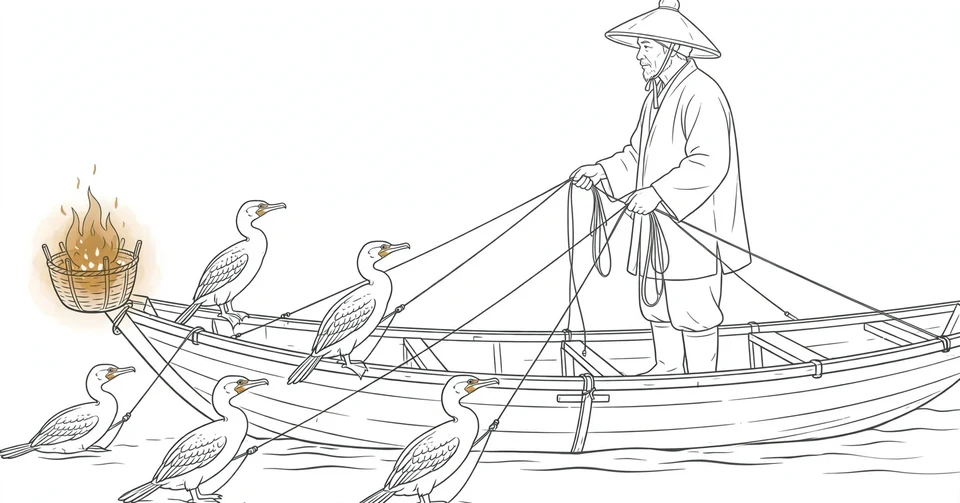
To understand the job, it helps to look past the spectacle at the household behind it. An usho keeps about twenty cormorants at his home near the river. His son, in many families, is learning the trade by rowing in the middle of the boat. And his working year begins long before the first fire is lit in May, because the birds need him every single day, in season and out of it.
An usho is a title, not just a job
Men who fish with cormorants exist on a dozen rivers in Japan, and almost everywhere they are called u-zukai, cormorant handlers. On the Nagara they are usho, and the difference is a title with a pedigree. Local tradition credits the warlord Oda Nobunaga, who ruled from Gifu Castle in the sixteenth century, with creating the title for the Nagara masters, and only Nagara masters have ever carried it.
That distinction shapes how the work is understood. An usho is not simply a fisherman who happens to be very good. He is the current holder of an office, responsible for a method, a boat, a flock and a stretch of river. The fishing would still be fishing without the title, but it would not be quite the same institution. As local guides are careful to point out in accounts of what makes Nagara ukai special, the title belongs to this river alone, and the men guard it accordingly.
On the payroll of the Imperial Household
The six usho who work the Gifu stretch of the Nagara are employees of the Imperial Household Agency, attached to its Board of Ceremonies. In plain terms, a man who goes to work in a straw skirt, carrying a basket of burning pinewood, is a national government employee. The appointment is hereditary and passes from father to son. The masters downstream at Seki, on the same river, hold the same appointment, which makes the Nagara the only river in Japan where the emperor's household effectively keeps its own fishermen.
The connection is practical, not decorative. The first sweetfish of each season are still sent to the capital, as they have been for centuries. Eight times a year the fishing is performed as a formal imperial viewing, though the public can watch on those nights too, and fish from the imperial fishing are offered to the Imperial family and to the great shrines at Ise and Meiji. The documented history of cormorant fishing on the Nagara River shows the imperial thread running through the whole story, from protection to presentation.
There is a quiet bargain inside that arrangement. Because the fishing belonged to the Imperial Household, the Nagara was treated as a protected river, guarded against the pollution and overfishing that degraded so many other Japanese waterways. The usho inherited a clean river because his office helped keep it clean, and his office survived because the river stayed worth fishing. Patronage preserved the technique, and the technique, in return, gave the patronage something living to protect.
The job has outlived several economies. Ukai on the Nagara began as a way for families to feed themselves, grew into an industry whose catch was processed nearby and sold over great distances, and then faded as newer fishing methods and modern transport made cormorant fishing unnecessary as commerce. What remains is the same work in a new frame: the fishing is real, the fish are eaten, but the audience on the viewing boats is now what pays for the evening. Through every version of that economy, the usho's side of the bargain stayed constant. Somebody still had to stand at the bow.
The night itself, the fires, the viewing boats and the six boats sweeping down together at the end, belongs to the fishing rather than the fisherman, and it is the subject of our earlier account of the 1,300 years of ukai nights on the Nagara River. This piece is about the man standing at the bow.
Ten years before the bow is yours
Nobody becomes an usho quickly. Even the official summaries concede that it takes at least ten years to become a cormorant fishing master, and that decade is not spent in a classroom. It is spent in the boat and around the birds, in a strict order: first the river, then the birds, then the cords.
The cormorant boat, the ubune, runs about thirteen metres and carries a crew of three. The usho stands at the bow with the cords and the fire. In the middle sits the nakanori, a rower and assistant, and in a hereditary trade that seat is very often filled by the master's own son, absorbing the work from the inside years before it becomes his. At the stern, the tomonori steers. A boy who grows up in that middle seat has watched thousands of dives, hundreds of tangles and every kind of river weather before he is ever allowed to stand where his father stands.
I find something honest in a profession that refuses to be hurried. Ten years is not a training course; it is a filter. It keeps out everyone who merely likes the idea of the job, and leaves the men for whom the river at night is simply where life happens. It also carries a risk that hereditary systems always carry. A post that passes from father to son is only ever one unwilling generation away from ending, and every usho holding the cords tonight is there because, at some point, a son said yes.
The usho keeps twenty birds at home
The birds are umi-u, Japanese cormorants, a sea species larger and stronger than the river cormorant, built for working in current. They are not bred in aviaries for this purpose. They are caught wild on the Pacific coast at Hitachi in Ibaraki Prefecture and brought across Honshu to Gifu, where a young bird is trained gradually for two to three years before it can be trusted with a full night's work.
Each usho keeps about twenty of them at his home near the river, and the arrangement is the real foundation of the craft. The birds live with the family, are fed and watched by the same hands every day, and learn the master's voice, his timing and his temper. Local explanations of ukai return to this point again and again: the master and his birds work well together because they live together. A cormorant is not equipment. It is a colleague with feathers, moods and favourites, and the usho who forgets that will be reminded by a bird that simply refuses to dive.
In season, the master's day begins with selection. He chooses ten to twelve healthy birds for the evening and leaves the rest at home, a rotation judged by eye and long familiarity. The chosen birds go out hungry, because a hungry cormorant hunts, and the small fish they are allowed to swallow past the loose ring at the throat are effectively their wages. The prize they are hunting is ayu, the sweetfish that rules Japan's clear rivers, and a working bird can hold as many as six of them in its gullet at once before the usho draws in the cord and empties the catch by hand.
The cords, called tenawa, are strong, but the system has a deliberate mercy built into it. If a cord snags under a rock mid-dive, a trapped bird will drown, so the usho must be able to break the line instantly with a practised snap. That reflex, fast enough to save a bird underwater in the dark, is one of the things the ten years are actually for.
Dressed for sparks
An usho goes to work in clothes that have barely changed in centuries, and every piece of the outfit is an answer to a practical problem. On his head he wears the kazaori-eboshi, a cap folded from a flat piece of hemp cloth that shields his hair from the fire; in earlier days it also made room for a topknot. Across his chest sits the mune-ate, a vest that protects against sparks and heat. Around his waist is the koshimino, a handmade straw skirt that sheds water like a raincoat and offers a little warmth, worn over simple shorts.
Read as a uniform, it is flame management dressed in folk costume. The usho spends five months of nights standing in a wooden boat beside an open fire, leaning over black water with a dozen cords in his hands. Straw, hemp and a bare chest underneath are what centuries of trial settled on for that job. The costume survives for the same reason the cords and the fire basket survive: nothing better has been found for the work it has to do.
The outfit has acquired a second job in the tourist era. Before the viewing boats leave the dock, one of the masters gives a short talk to the waiting visitors, a live cormorant beside him, explaining the history of the fishing, the meaning of the costume and how the birds work. It is a strange extra duty for a hereditary imperial fisherman, part guide, part exhibit, part teacher. The usho carry it as part of the modern office, because a tradition nobody explains eventually becomes a tradition nobody understands.
A season of nights, a lifetime of birds
The season an usho works runs from May 11 to October 15, almost every night for five months. There are two standing exceptions: fishing stops when the river runs too high to be safe, and it rests on the night of the harvest moon, traditionally so that the moon can have the river to itself. Everything else is simply work, an evening appointment with fire and feathers that a master keeps more than one hundred and fifty times a year, year after year, often for half a century.
Each of those evenings runs on ritual as much as routine. The birds are chosen, the boats are prepared, and then the six masters draw ropes to settle the order in which they will come down the river, a small daily lottery among men who have fished side by side for decades. Only after the order is set do the fireworks go up and the first boat push off into the dark, its fire the signal that the office, once again, is open for the night.
When October ends, the fires go out, the viewing boats are put away, and Gifu's famous summer scene dissolves. The usho's life does not dissolve with it. Twenty cormorants still need feeding through the winter. Young birds from the Ibaraki coast still need their slow training. Gear still needs mending, and a son in the middle of the boat still needs watching over, the way the master himself was once watched.
Most heritage crafts survive because someone funds them, and the usho has the Imperial Household for that. But funding is not what makes a man spend fifty years of nights on the same dark river, reading a dozen cords by firelight. That part is older than any agency, and it is kept alive one household at a time: a master, his birds in the yard, and the assumption, renewed each spring, that the fire will be lit again.
More in Culture & Society
Latest posts
- Kombu Is the Quiet Half of Dashi
- Manza Onsen Bathes at 1,800 Metres
- Every Prefecture Argues About What Goes in Ozoni
- KRL Commuterline and the Trains That Move Jakarta
- Kecap Manis and the Sweet Soy Sauce of Indonesia
- In Mamoiada, Two Hundred Families Still Make Wine at Home
- Shochu and the Quiet Spirit of Japan
- A Dried Shiitake Is Louder Than a Fresh One
- Loma Linda's Long Lives Run on Saturdays
- Maruten Numazu and the Towering Kakiage Bowl of the Port
- The Three Sisters Grow Better Together
- Tatamiishi Terraces Filter a River Through Stone
- Wasabi-Zuke Puts the Whole Plant in Sake Lees
- Konyoku Is Still Out There, Past the Last Train Station
- Dry January Lasts a Month on Purpose