The Hachiko Story, the Dog Who Waited Nine Years
· 9 min read
The Hachiko story is the tale of an Akita who waited at Shibuya Station for his owner for almost ten years, long after the man had died. This is what happened, and why the world still remembers it.
Every evening, just before six o'clock, a brown and white Akita dog walked to Shibuya Station in Tokyo and waited by the ticket gate. He was waiting for one man, Professor Hidesaburo Ueno. When the professor stepped off the train, the dog greeted him, and the two walked home together. The Hachiko story begins with that small daily routine, and it became famous because the routine did not stop when the man stopped coming.
On 21 May 1925, Professor Ueno died suddenly at work, at the University of Tokyo. He never came home. Hachiko, who was less than two years old, went back to Shibuya Station the next evening anyway, and the evening after that, and the evening after that, for almost ten years, until his own death on 8 March 1935. The Hachiko story is not a story about a clever dog. It is a story about loyalty that outlasted the person it was given to, and that is why people in Japan and around the world still tell the Hachiko story.
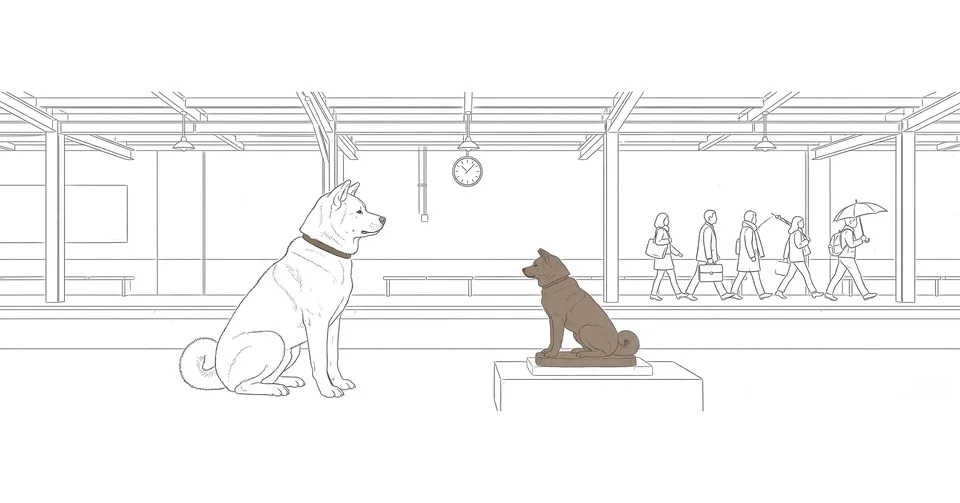
The dog who met the train every evening
Hachiko was born in 1923 in Odate, a town in Akita Prefecture in northern Japan. He was an Akita, a large breed from that region, known for its thick coat and calm, serious face. In January 1924, still a puppy, he was sent to Tokyo to live with Professor Hidesaburo Ueno, who taught agriculture at the University of Tokyo.
The professor lived in Shibuya and commuted by train. Hachiko soon learned the rhythm of the day. In the morning he walked with Ueno to the station, and in the evening he walked back alone and waited by the gate. When Ueno appeared, the dog ran to him. The small ritual lasted about a year and a half.
There is nothing unusual about a dog that waits for its owner. Dogs do it everywhere. What made the Hachiko story different was what happened when the waiting had no reason to continue, and the dog continued anyway.
The day Ueno did not come home
On 21 May 1925, Professor Ueno suffered a brain haemorrhage while giving a lecture at the university. He died the same day, at the age of 53. Hachiko was at home. The professor's family held the funeral, and the dog was given to relatives and friends in turn. Hachiko kept escaping and returning to the Ueno house, and then he started going to Shibuya Station again, in the evening, at the same time as before.
At first, people thought he was lost. Then they noticed the pattern: the same dog, the same hour, the same spot, day after day. Station staff began to feed him, and passers-by gave him food and water. He did not beg. He sat and watched the gate, waiting for a train that would never bring his owner back.
The Hachiko story is often told as if the dog understood what had happened. He almost certainly did not. Dogs do not understand death the way people do. What Hachiko understood was a routine: this place, this hour, this person. The routine had become his whole day, and he kept it because it was the only thing he had left of the man. That is the saddest part of the Hachiko story, and it is also the most honest.
Nine years at the station
The waiting in the Hachiko story went on for nine years, ten months, and seventeen days. He was moved to other homes several times, and each time he found his way back to Shibuya or to the Ueno house. In the end, a former student of Professor Ueno, Kikuzaburo Kobayashi, took him in and let him live as he wished, which meant daily trips to the station.
The dog became a familiar sight. In 1932, a reporter named Hirokichi Saito wrote about him in the Asahi Shimbun, one of Japan's biggest newspapers, and the article made Hachiko famous across the country. People came to the station just to see him. In April 1934, a bronze statue was unveiled at the station, with Hachiko himself present at the ceremony. He was eleven years old by then, and his health was failing.
Hachiko died on 8 March 1935, on a street near Shibuya Station, aged eleven. A post-mortem examination found that he had terminal cancer and a parasitic worm infection. His stuffed and preserved body is on display at the National Museum of Nature and Science in Tokyo, in Ueno Park, not far from the university where his owner once worked.
| Year | What happened |
|---|---|
| 1923 | Hachiko is born in Odate, Akita Prefecture |
| 1924 | He moves to Tokyo to live with Professor Ueno |
| 1925 | Ueno dies on 21 May; Hachiko begins waiting at Shibuya Station |
| 1932 | A newspaper article makes him famous across Japan |
| 1934 | A bronze statue is unveiled at Shibuya Station, with Hachiko present |
| 1935 | Hachiko dies on 8 March, aged 11 |
| 1944 | The statue is melted down for metal during the Second World War |
| 1948 | The statue is rebuilt and unveiled again |
The dates matter in the Hachiko story because they show how long the waiting lasted. Nine years is a long time for a dog. It is most of a dog's life. Hachiko spent most of his adult life waiting at a station for someone who was never coming back, and he did it without complaint and without reward. That is the heart of the Hachiko story, and it is why the story still works on people who hear it for the first time.
The statue at Shibuya
The statue at Shibuya Station is now one of the most famous meeting points in Japan. "Meet me at Hachiko" is a sentence every Tokyo resident understands. The statue stands outside the Hachiko exit of Shibuya Station, facing the crossing that is said to be the busiest in the world. On a normal day, a small crowd gathers around it at all hours, taking photographs and waiting for friends.
The statue standing there today is not the original. The first, unveiled in 1934, was melted down in 1944, during the Second World War, when Japan needed metal for the war effort. After the war, in 1948, a new statue was made by the original sculptor's son and unveiled in the same spot. The replacement is so faithful that most visitors never know it is a copy.
The statue has also become a place for small rituals. People leave flowers there. On the anniversary of Hachiko's death, 8 March, a small ceremony is still held at the station. The dog that waited for one man has become a meeting point for millions of people, which is a strange and fitting end to the Hachiko story. The Hachiko story began with two people walking home together, and it ended with a whole city using the dog as a landmark.
Why the Hachiko story travelled the world
The Hachiko story did not stay in Japan. It spread because loyalty is a value that every culture recognises, and because the story is simple enough to tell in a minute and hard enough to forget. In 1987, a Japanese film called Hachiko Monogatari told his life in full. In 2009, an American remake, Hachi: A Dog's Tale, starring Richard Gere, brought the story to a new audience around the world. The American version moved the setting to a small town in the United States, but it kept the heart of the story: the dog, the station, and the waiting.
The Hachiko story is not the only tale of a loyal dog in the world. Greyfriars Bobby in Edinburgh guarded his owner's grave for fourteen years, but Hachiko is different in one important way. Bobby waited at a grave, a place of rest. Hachiko waited at a station, a place of arrival. He was not guarding the dead. He was expecting the living. That is what makes the Hachiko story so painful and so beautiful at the same time. He was not looking backwards. He was looking forward, every evening, to a reunion that would never happen.
The Hachiko story also says something about Japan itself. Loyalty, chuugi, is an old virtue there, and devotion to one person or one duty runs deep in Japanese culture. Hachiko became a symbol of that virtue, not because he understood it, but because he lived it without thinking about it. The statue was not built to honour a clever dog. It was built to honour a dog that did one thing, faithfully, for almost ten years, and never asked why.
Visiting Hachiko today
If you go to Tokyo, seeing Hachiko is easy. Take any train to Shibuya Station, which is one of the busiest stations in the city, and follow the signs to the Hachiko exit. The statue is just outside, on the side of the station facing the famous crossing. It is busiest in the evenings and at weekends, so go in the morning if you want a quiet moment and a clear photograph.
The statue is worth five minutes, but the real experience is the station itself. Shibuya Station handles millions of passengers, and the crossing outside moves thousands of people on a single green light. The Hachiko story feels closest here. Stand at the statue and watch the crowd, then imagine the same place a hundred years ago, quieter and smaller, with one dog sitting by the gate, waiting for the evening train.
Hachiko himself is preserved at the National Museum of Nature and Science in Ueno Park, in Tokyo. It is a strange thing to see, a famous dog behind glass, but it is a reminder that Hachiko was a real animal, not a legend. He was born, he lived, he waited, and he died, and the story survived him because people could not let it go.
The Hachiko story ends the way it began, at a station, with a dog waiting for someone he loved. The train never brought the professor home. But the waiting itself became something larger than the two of them. The Hachiko story teaches us something that no book about loyalty can teach: devotion is not a feeling, it is a habit, repeated every day, even when there is no reason left to repeat it. That is why, a century later, people still stop at a bronze dog in Shibuya, take a photograph, and remember a man and his dog walking home together.
More in Culture & Society
Latest posts
- Dashi, the Quiet Stock Under Almost Everything Japan Cooks
- Ayu, the Sweetfish That Rules Japan's Clear Rivers
- Gensen Kakenagashi, the Onsen Water That Never Circles Back
- Sumadori, Japan's Smart Drinking for People Who Do Not Drink
- Sake Kasu, the Sake Lees Japan Cooks With Instead of Throwing Away
- Bureiko, the Drinking Party Where Rank Is Left at the Door
- Kopi Tubruk and the Indonesian Way to Drink Coffee
- Capsule Hotels and Sleeping in a Pod in Japan
- Subak and the Rice Terraces of Bali
- Shinnenkai, Japan's New Year Parties That Start the Year Over
- Nara Deer and the Sacred Animals of the Old Capital
- Punakawan, the Clown Servants Who Steal Every Wayang Show
- Kashikiri, the Private Onsen Bath You Book by the Hour
- Nomi-Hara, When After-Work Drinks in Japan Turn Into Harassment
- Shio Koji, Japan's Salted Ferment That Seasons Everything