Mishima Skywalk, Japan's Longest Bridge With a View of Mount Fuji
· 8 min read
The Mishima Skywalk is the longest pedestrian suspension bridge in Japan, a 400 metre walkway in Shizuoka that frames Mount Fuji, Suruga Bay and the Izu mountains in a single view.
Some bridges exist to get you somewhere. The Mishima Skywalk exists to make you stop in the middle. It is a pedestrian suspension bridge 400 metres long, strung across a green valley in the hills above Mishima, Shizuoka, and since it opened it has held the title of the longest footbridge in Japan.
What the walk gives you is a rare trick of geography. From the middle of the Mishima Skywalk, Mount Fuji fills one side of the view while Suruga Bay opens on the other, Japan's highest mountain and Japan's deepest bay held in a single glance. Very few viewpoints anywhere offer that pairing.
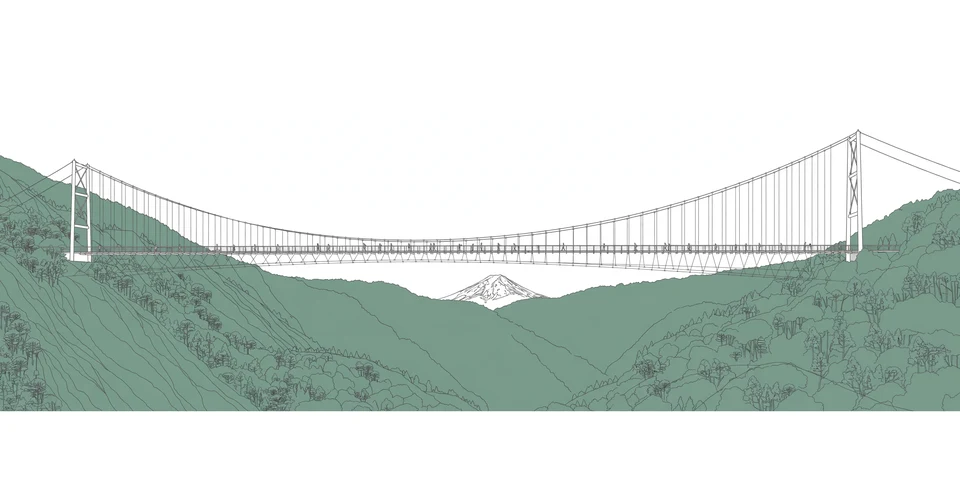
The bridge hangs in the western foothills of Hakone at an elevation of about 415 metres, high enough that the cities below look tidy and small. On a clear day the view runs from Fuji across to the mountains of the Izu Peninsula, with Mishima and its neighbour Numazu spread out underneath. For travellers crossing the region, the Mishima Skywalk has become an easy anchor for a day in eastern Shizuoka.
Three Japanese records in one frame
The numbers line up neatly. Mount Fuji rises 3,776 metres, the highest mountain in Japan. Suruga Bay drops to a maximum depth of roughly 2,500 metres, the deepest bay in the country. And the Mishima Skywalk itself, at 400 metres, is the longest pedestrian suspension bridge in Japan. Stand at its midpoint and all three records are in front of you at once.
That framing changes how Fuji feels. Most people meet the mountain from its own slopes, head down on volcanic gravel, watching their footing. The climbers who bullet climb Mount Fuji through the night get the summit, but not always the portrait. From the Mishima Skywalk you get the portrait first: the full, symmetrical cone, floating above the bay exactly the way it appears on postcards and old woodblock prints.
The bay deserves equal billing. Suruga Bay is not a gentle shelf of water. It falls away steeply from the shore, which is why the fishing ports along it land deep sea species that other coasts never see. From the bridge you are looking at the surface of the deepest water in Japan, with the highest land in Japan behind you in the same turn of the head.
One practical note from my own visits to Fuji viewpoints in this area: go early if you can. The mountain is shy, and cloud tends to gather around the summit as the day warms up. A morning crossing of the Mishima Skywalk gives you the best odds of the full, unobstructed portrait, with the bay still silver and the Izu ridges stacked in blue layers behind it.
The numbers behind the Mishima Skywalk
The official name is longer than the bridge's nickname: Hakone Seiroku Mishima Suspension Bridge. The Mishima Skywalk opened on 14 December 2015, and it took its record from the Kokonoe Yume Suspension Bridge in Oita, which measures 390 metres. Ten metres is not much of a margin, but a record is a record, and the bridge's Wikipedia entry keeps the figures straight.
The deck hangs about 70 metres above the valley floor, 70.6 metres at the highest point, and the walkway is 1.6 metres wide. That width was a deliberate kindness. It lets two wheelchair users pass each other comfortably, so the view is not limited to people who can climb or scramble. The railings use a high transparency mesh, and the vertical suspension cables are spaced wider than on a typical footbridge, both choices made so that nothing interrupts the panorama.
Behind the elegance sits serious engineering. The bridge was built by Fujiko Corporation, a local tourism company, for around 4 billion yen, after nearly a decade of planning. The structure is designed to carry a load of 200 kilograms per square metre, and seismic dampers are fitted to absorb the energy of a major earthquake. This is Japan, after all. Even a bridge built purely for looking at scenery has to be ready for the ground to move.
The setting makes the investment more striking. The Mishima Skywalk stands in Sasahara Shinden, a corner of Mishima that was largely undeveloped and known mainly to mountain climbers before the bridge arrived. The company has said it built the bridge to let more people enjoy scenery that only a few had ever seen, and to give something back to the local community. Judging by the crowds on a fine weekend, the scenery was worth sharing.
A slow walk, by design
Crossing takes longer than the distance suggests, and that is the point. People drift. They stop at the midpoint, lean on the mesh, take the same photograph everyone takes, and then take ten more as the light shifts. The Mishima Skywalk sways just enough to remind you that you are suspended in the air, and no more than that. Nobody hurries here. The Mishima Skywalk seems to slow people down by design, and it is a better experience for it.
The scene around it keeps changing through the year. Spring and early summer dress the valley in fresh green. Around June, the walking paths beyond the bridge fill with hydrangeas, some 13,000 plants in 205 varieties, including varieties found only here. Late in the day the whole arrangement turns gold, and the sunset side of the Mishima Skywalk is, to my mind, the finest hour to be on it.
What I like most is how hard the bridge works to disappear. The raised cables, the see through railings, the plain deck, everything steps back so the landscape does the talking. Plenty of attractions shout. This one holds still and lets Fuji speak.
More than a viewpoint
The far side of the bridge is not just a turnaround point. The Long Zip Slide runs alongside the Mishima Skywalk, a 560 metre round trip that sends riders gliding out over the valley facing Mount Fuji and the bridge itself. It is the one part of the site that refuses to be calm, and it is very popular for exactly that reason.
In the forest nearby, Forest Adventure has built an obstacle park in the trees, with harnessed courses strung between the trunks. There are also Segway guided tours and off road buggies that use the natural terrain. The GOOD LUCK TRIP guide to the Mishima Skywalk lists the activities and the practical details, from opening hours to access, in one place.
There is food, too, which matters on this site. The grounds on either side of the bridge hold cafes, restaurants and shops. At Forest Kitchen, the restaurant, the menu runs from curries and pancakes made with local ingredients to Mishima croquettes, a local favourite given the house treatment. Sky Garden sells local specialities and more Mount Fuji themed goods than you would think existed. Nobody crosses the Mishima Skywalk for lunch, but nobody leaves hungry either.
The formula has clearly worked. More than seven million people visited in the years after the opening, a remarkable number for a bridge in a modest provincial city. The Mishima Skywalk did not just add an attraction to the map. It gave this corner of Shizuoka a landmark that travellers plan around.
Mishima below, Numazu next door
It is worth coming down from the hills afterwards, because Mishima itself is a pleasure. The city is known as a city of water. Snow and rain that fell on Mount Fuji travel underground through old lava flows and rise again as springs in the middle of town, feeding the clear Genbe River that runs through the centre. The river runs for about 1.5 kilometres through ordinary neighbourhoods, with stepping stones and wooden paths set right into the stream, and its water stays at a cool 15 to 16 degrees all year. Locals stroll it the way other towns stroll a shopping street. Walking it after the bridge makes a neat pairing: Fuji's water below you in the morning, Fuji itself in front of you by afternoon.
Access is simple. The Mishima Skywalk is about 20 minutes by taxi from JR Mishima Station, and drivers can reach it in roughly 15 minutes from the Numazu interchange. That second detail matters, because Numazu is where I would send you next. The harbour city next door is the natural lunch stop after a morning on the bridge, as the fresh seafood at Numazu Port makes a strong case on its own. Bridge in the morning, sashimi by the water at noon. Eastern Shizuoka rewards anyone who links the two.
A record you can walk across
Records are usually things you read on a plaque. The Mishima Skywalk is a record you can stand on, 400 metres of it, with the wind coming up the valley and the country's highest mountain and deepest bay arranged in front of you like an exhibit.
It never feels like an engineering trophy, though. It feels like a front row seat that someone thoughtful built in exactly the right place, then stepped aside. If you come to Shizuoka for Fuji, give the mountain one viewing from the valley it watches over. The bridge is patient. It will hold still, and so, for a few minutes in the middle, will you.
More in Food & Travel
- Katsuobushi Is a Fish You Shave Like a Block of Wood
- Why Kagami Mochi Is Never Cut With a Knife
- Narazuke Pickles Spend Years Asleep in Sake Lees
- Tomozuri Sends a Living Fish to Do the Fishing
- Dashi, the Quiet Stock Under Almost Everything Japan Cooks
- Ayu, the Sweetfish That Rules Japan's Clear Rivers
Latest posts
- A Rotenburo Is a Bath With Weather
- The Tengger Carry Their Dead Out of the Village in Entas-Entas
- Urashima Opened the Tamatebako and Time Came to Collect
- How Supersemar Borrowed the Authority of a God
- Bali Has Its Own Semar, and His Name Is Twalen
- White Silk Means You Made It as a Sekitori
- The Dohyo-Iri Gives a Yokozuna Three Minutes to Own the Ring
- Nobody Commutes to a Heya
- Tokyo Keeps a Hundred Tiny Fujis Called Fujizuka
- One Thousand Three Hundred Years of Ukai Nights on the Nagara River
- Fuji Ko, the Pilgrim Societies That Climbed Mount Fuji Together
- Gensen Kakenagashi, the Onsen Water That Never Circles Back
- Shiko, the Leg Stamp That Starts Every Sumo Day
- Semar, the God Who Chose to Work as a Servant
- Kyushoku and the Japanese School Lunch