Six Months of Mold Later, a Fish Becomes Honkarebushi
· 11 min read
Honkarebushi is katsuobushi that refused to stop at smoke. Months of mold, sun and patience turn a rough smoked fillet into the true dried fillet behind the finest dashi in Japan.
Knock two finished blocks of honkarebushi together and they do not thud. They ring, with a clear, hard note closer to wood or stone than to anything that once swam. That sound is the finish line of one of the longest roads any ingredient travels in Japanese cooking.
Most of the bonito flakes sold around the world never get there. They stop at the smoked stage, a rough black fillet called arabushi, and they are good enough for everyday cooking. Honkarebushi is what happens when a maker refuses to stop at smoke, and instead hands the fish over to mold, sun and time for months more.
The distinction is not marketing. By the strict definition, only a fillet that has passed through the mold fermentation stage may be called katsuobushi at all, and honkarebushi, the true dried fillet, sits at the very top of that ladder. Everything about it, the hardness, the colour inside, the depth it gives a broth, is earned in that extra half year of work.
To understand why the mold months matter, it helps to start where the smoke ends, because honkarebushi begins as an ordinary, if very blackened, piece of fish.
It starts as arabushi, a fish full of smoke
The raw material is skipjack tuna, called katsuo in Japan. The fish is filleted, simmered gently for an hour or so to firm the flesh, and then deboned by hand, one small bone at a time, because any bone left inside would warp the fillet as it dries. What follows is the smoking, and it is not a single smoking but a campaign of them.
The fillets go into a wood fired smoker for four to six hours, then come out to rest and cool. The rest matters as much as the fire. While the fillet cools, moisture from its wet core slowly migrates outward, and the next fire can carry that moisture away. Smoke the fish continuously and the surface would harden into a shell around a damp centre. So the cycle repeats, ten to fifteen fires over as much as a month, until the fillet is dry, black and coated in tar from the smoke. I walked through this whole fiery apprenticeship in my article on katsuobushi, the fish you shave like a block of wood.
The work is fussy long before any mold appears. Fillets cracked or holed by the smoking are repaired by hand, the gaps filled with a paste of the fish's own cooked and raw meat, patted smooth like plaster, so the finished block will shave evenly. In the Edo period some makers went further still with the tebiyama style, steaming the fillets in stacked baskets over a wood fire before the smoking even began, which produced a richer fillet that resisted spoiling. It was expensive in fuel, space and labour, and only a handful of factories keep that older road alive today.
At this point the fillet is arabushi, the rough fillet, also nicknamed onibushi, the demon fillet, for its charred black look. It keeps well, it smells powerfully of smoke, and shaved thin it becomes the hanakatsuo flakes scattered over tofu and okonomiyaki everywhere. But for all its drama it is unfinished. More than a quarter of its weight is still water, and under the tar it still carries the fish's fat, which will slowly turn and coarsen the flavour if it is left in place. Arabushi is a preserved fish. What it is not yet is a fermented one.
The mold moves in
Before any mold is allowed near it, the arabushi is scraped clean. Workers grind and shave away the tarry crust and the fat that has risen to the surface, until the fillet is smooth. In that scraped, cleaned state it has another name, hadakabushi, the naked fillet. The smooth surface is not vanity. Mold needs an even skin to take hold of, and fat left on the surface would feed the wrong flavours.
The naked fillets are then inoculated with a cultivated mold from the Aspergillus glaucus group, close relatives of the koji mold that starts sake and miso, and laid away in a closed cultivation room called a muro, where temperature and humidity are held steady for them. Within a few days the surface blooms. Fine threads of the fungus reach down into the flesh, and the fillet sits under its pale coat for up to two weeks while the mold quietly works.
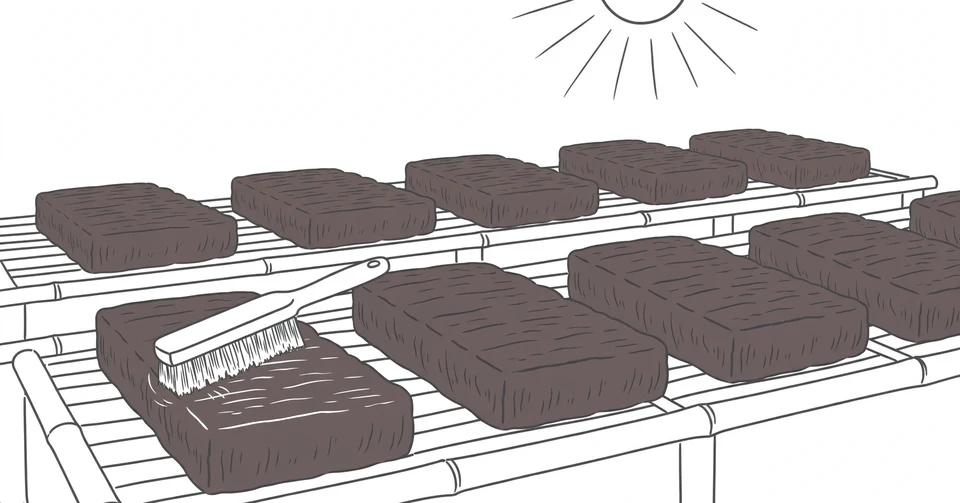
Then the rhythm that defines honkarebushi begins. The mold is brushed and scraped off. The fillets go out into the sun to dry. Then they are inoculated again, rested again, brushed again, sunned again. After two full rounds of this, the fillet has earned the name karebushi, dried fillet. Only when the cycle has repeated three or more times is it honkarebushi. The katsuobushi entry on Wikipedia records the strict naming ladder, and it is a ladder with no shortcuts: smoke alone never gets a fillet onto it.
The sun drying days carry their own anxiety. By the later cycles the fillets are so dry and so valuable that a single drip of rain during a day in the sun can mark one permanently. This is slow work done outdoors, at the mercy of weather, on an ingredient that has already absorbed months of labour.
What the mold actually does to the fish
It is tempting to imagine the mold as a flavouring, something added to the fish. The truth is closer to the opposite. The mold on a block of honkarebushi is one of the great subtractors in the food world. Almost everything it does is a removal.
First, it removes water. The fungal threads grow into the fillet and draw residual moisture out of the flesh, cycle by cycle, in a way that fire alone could not finish without cooking the fish. The Japanese Food Lab's account of the process puts the finished fillet at around 12 to 15 percent water, down from the 25 percent or more that arabushi still holds, and a finished block weighs less than a fifth of the fresh fish it came from.
Second, it removes fat. The mold digests the leftover fat in the flesh, and this is the quiet reason honkarebushi tastes clean where arabushi can taste coarse. Fat left in a dried fish oxidises over time and drags the flavour toward rancidity and smoke. Strip it away and what remains keeps almost indefinitely, a stable, hard little ingot of fish.
Third, and this is the part you can taste, the mold's enzymes go to work on the proteins and deepen the fillet's inosinic acid, the compound behind the savoury punch of bonito. The smoke flavour that dominates arabushi retreats into the background, and in its place comes something rounder and more concentrated. Cut a finished block open and the inside is a surprise after the dull beige grey exterior: a translucent, deep ruby red, like a piece of polished stone.
The choice of mold is not accidental either. The Aspergillus glaucus group belongs to the same family as Aspergillus oryzae, the koji mold behind sake, miso and soy sauce, but the two have divided the labour of Japanese fermentation between them. Koji is the starch specialist, turning rice sugars loose for yeast and bacteria to work on. The katsuobushi molds are protein specialists, far better at breaking down amino acids in flesh, which is exactly the skill a dried fish needs. One family of fungi, two trades, and between them they season half the Japanese kitchen.
I find something admirable in a delicacy built almost entirely out of taking things away. So much of celebrated cooking is addition, more butter, more garnish, more technique stacked on technique. Honkarebushi is made by water leaving, fat leaving, harshness leaving, until what is left is the fish in its most concentrated form.
Honkarebushi, a grade earned by the calendar
Because the name depends on cycles and time, honkarebushi is as much a grade as a stage. The full journey from a landed skipjack to a finished block takes the better part of six months for a fine piece, and the most extreme examples are kept cycling through mold and sun for over two years. Every extra round costs the maker space, labour and risk, which is why true honkarebushi has always been a small, expensive fraction of production, while the world's supermarket shelves fill up with arabushi flakes.
Makers judge the result with disarmingly simple tests. Two blocks knocked together should give that clear, almost metallic note, the ring of something with almost no water left in it. A block that sounds dull is not finished, whatever the calendar says. And the shaving tells the rest: honkarebushi is shaved fresh, ideally moments before it meets hot water, because its aroma is at its peak in the first breath after the blade passes. The thick, pale pink shavings curl off the block like wood shavings off a carpenter's plane, which is exactly the tool the traditional shaving box resembles.
None of this makes arabushi a fraud, and it is worth saying so plainly. Arabushi is honest food, and for most dishes its smoky directness is exactly right. Honkarebushi is simply the far end of the same road, the version for occasions when the fish itself is not the dish, but the seasoning that a whole dish will be built on.
Two ports still do it the slow way
The geography of honkarebushi is concentrated. Two ports dominate Japanese katsuobushi making: Makurazaki, on the southern tip of Kyushu in Kagoshima, which is famed above all for its honkarebushi, and Yaizu, in Shizuoka, the country's other great bonito port. In both towns the work grew up around the skipjack fleets, and the smoking houses and mold rooms followed the fish.
Makurazaki in particular built its name on patience. The town's makers leaned into the long fermented grades rather than volume alone, and honkarebushi became its signature. It is a fragile kind of fame. The process ties up money for months before a block can be sold, it depends on skilled hands at every scraping and brushing, and it competes against cheaper flakes that most eaters, most of the time, cannot tell apart once the food is on the table. That the slow version survives at all says something about how seriously Japan takes the flavour of its broth.
Why it ends in the finest dashi
Almost all of this effort is aimed at one destination: a pot of water. Honkarebushi exists to be shaved into dashi, and specifically into the clear, golden top grade of it that chefs call hon-dashi, brewed from honkarebushi and kombu kelp and nothing else. It is the stock under the clear soups of kaiseki dining, the places where a broth is served almost naked and has nowhere to hide.
The pairing is chemistry as much as tradition. Kombu brings glutamates, the savoury base note. The honkarebushi brings inosinates, concentrated by all those months of mold. Put the two together and each multiplies the other, producing a depth of umami that neither reaches alone, in a liquid that stays transparent and clean. I explained that quiet partnership in more detail in my piece on dashi, the stock under almost everything Japan cooks. With ordinary arabushi the same broth leans smoky and rustic. With honkarebushi it turns refined, the fish present as depth rather than as smoke.
For a home cook, the honest summary is this. The bag of arabushi flakes in the cupboard is the right tool for Tuesday's miso soup, and nobody's dinner will suffer for it. Honkarebushi is for the cook who wants to understand what dashi can be when nothing is left in the fish except flavour, and who is willing to shave a block of fish scented wood to find out.
A fillet of honkarebushi on a shelf looks like the least promising object in the kitchen, a dull grey brown lump that could be firewood. But everything about it is a lesson in what time and a well chosen mold can do. Six months of mold later, the fish has not been decorated or disguised. It has been reduced to its essence, and that essence, shaved into hot water with a piece of kelp, is enough to carry an entire cuisine.
More in Food & Travel
Latest posts
- Toji Meant Moving to a Hot Spring Until You Got Better
- Sodoran Treats an Heirloom Like an Honoured Guest
- You Can Read a Pecalang From Across the Street
- Nyuto Onsen Hides Seven Inns at the End of a Snow Road
- Nobody Just Watches a Panigyria, Everybody Dances
- When the Gara-Gara Starts, the Puppets Drop the Plot
- Forty Pounds of Cowbells, and the Mamuthones Say Nothing
- The Oarfish Still Answers to a Name From the Dragon Palace
- Manza Onsen Bathes at 1,800 Metres
- Irezumi Was an Art Before It Was a Warning
- The Oshi Kept Fuji's Pilgrims Fed, Housed, and Devout
- Japan's Population Decline and the Villages It Leaves Behind
- KRL Commuterline and the Trains That Move Jakarta
- Kecap Manis and the Sweet Soy Sauce of Indonesia
- In Mamoiada, Two Hundred Families Still Make Wine at Home