The Tsukebito Bow to Wrestlers They Once Outranked
· 11 min read
A tsukebito is the junior wrestler who cooks, cleans and carries for a salaried sekitori, and because sumo promotion ignores seniority, he can end up serving a man who once took orders from him.
On the morning a sumo wrestler wins promotion to the salaried ranks, the stable assigns him a personal attendant. That attendant is a tsukebito, a junior wrestler from the same stable who will cook for him, clean for him, carry his belongings and stand ready at his elbow for as long as the senior man keeps his rank. It is one of the oldest jobs in sumo, and almost nobody outside the sport has heard of it.
The strange part is who gets picked. A tsukebito is chosen by rank, not by age and not by the date he joined the stable. Sumo promotion runs on tournament wins alone, so a gifted teenager can climb past a wrestler who entered years before him, and the man who once gave the orders can wake up one morning as the new sekitori's servant.
Our article on the men at the top of the sport called such attendants the servants who were once his seniors in everything but name, and the phrase is meant literally. Inside a stable, the tsukebito is where sumo's two hierarchies collide, and the collision is absorbed quietly, every single day, by the man holding the bags.
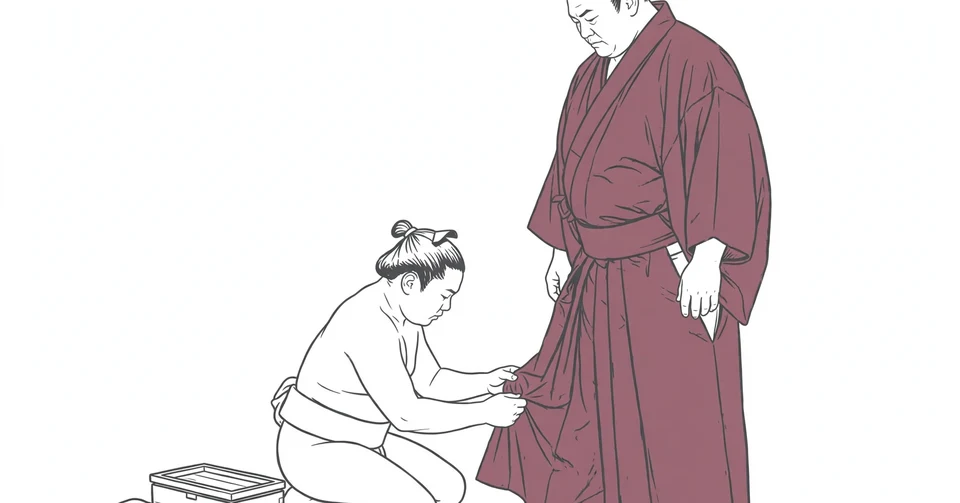
None of this is written on the ranking sheet. The banzuke shows wins and losses, not who sews, scrubs and waits in corridors. To understand what a tsukebito really is, you have to follow one through a full day, because the job is not a task. It is a position inside a household that runs on rank the way other households run on money.
What a tsukebito does all day
A tsukebito starts his day with the other junior wrestlers, before dawn. The lowest ranks rise around four or five in the morning to clean the building, stretch, and begin cooking for the whole stable. When the senior wrestlers finally appear for morning practice, a tsukebito may have to step out of his own training to help his master into the thick training mawashi, then hurry back to the practice floor and try to catch up on the work his body was supposed to be doing.
After training, the day stays physical. The tsukebito helps with the bath, because bathing in a stable follows rank order and the sekitori goes first, into clean water. He works in the kitchen that produces the stable's great communal hot pot. He does the laundry. He keeps his master's room and belongings in order. When the sekitori needs money from the bank, a document delivered, a drink brought or a schedule remembered, the tsukebito is the one who moves. As The Japan Times puts it in its guide to the role, virtually any task you can imagine falls within the tsukebito's remit.
Meals follow the same order as everything else. The stable eats in turns by rank, each man served by someone ranked below him, and the juniors wait, hungry from a morning of training done on an empty stomach, until the senior men have finished and gone off to nap. A tsukebito serving his master at the table is doing the most ordinary version of his job, and doing it last in line for his own lunch. Even the morning greeting runs downhill. When a sekitori walks into the training hall, every lower ranked wrestler present greets him, and his tsukebito is simply the one whose greeting comes with a full day of work attached to it.
The stable is the natural home of this arrangement. As our look at life inside a heya describes, wrestlers live under one roof and eat from the same pot, so personal service is not an office perk bolted onto the sport. It is simply the top layer of a house where every man is served by someone below him and serves someone above. The tsukebito sits at the sharp end of that chain, attached not to the house in general but to one man in particular.
The number of attendants grows with rank. A newly promoted wrestler in the juryo division, the second highest, is assigned at least one tsukebito, often two. The higher a sekitori climbs, the more help he is entitled to, and a yokozuna at the very top may move through his day with eight or ten tsukebito around him. Stablemasters keep attendants of their own. When a small stable runs short of juniors, it can even borrow a young wrestler from another stable to fill the role, because a sekitori without a tsukebito is treated as a gap in the order of things, not a saving.
Two ladders that refuse to match
To see why a tsukebito so often serves a younger man, you have to know that a stable keeps two separate ladders. The first is seniority. Among the junior wrestlers, authority follows the date a man entered the stable. An earlier entrant is an anideshi, a big brother, and the later arrivals are his otōtodeshi, his little brothers, who obey him in the kitchen, in the dormitory and on the practice floor. This ladder is fixed. Nobody can climb it faster than time allows.
The second ladder is the ranking itself, and it ignores the first one completely. Six tournaments a year decide everything, and the record of wins and losses is the only argument that counts. A strong nineteen year old can pass a twenty six year old who has been in the stable since they were both boys. The day the younger man reaches juryo, he becomes a sekitori: salaried, entitled to a private room, addressed with an honorific, and owed service. The older man, still in the unpaid divisions, owes it. If he is assigned as the new star's tsukebito, the big brother kneels to tie the little brother's robe.
People inside sumo say the difference between the salaried divisions and the one just below is like heaven and hell, and the tsukebito system is where that gap becomes personal. Below the line there is no monthly salary at all, only a modest allowance paid at tournaments. Above the line there is a salary, better clothes, your name painted on banners outside the arena, and a young man whose job is to make your life easy. The cruelty of it, if you want to call it that, is not that the system is rigged. It is that the system is perfectly fair, and fairness still asks a man to bow to someone he used to scold.
I find it hard to call the arrangement simple exploitation, because the same wheel keeps turning for everyone. A sekitori who loses his rank falls back into the unpaid divisions and loses his attendants along with his salary, and nothing prevents him from ending up in service again, possibly to a man who once carried his bags. Everyone in the building knows the wheel turns. That shared knowledge does something to the atmosphere of the place. It does not remove the hierarchy, but it seasons it.
Tournament days, where you can see them
If you watch a tournament broadcast you have seen tsukebito without knowing it. They are the young wrestlers in plain yukata moving through the arena corridors ahead of the stars. A sekitori's belongings travel in an akeni, a flat luggage box of bamboo and washi paper that dates back to the Edo period, and it is the tsukebito who carries it in and out. Each wrestler has one box with his name on it, though a yokozuna, buried in ceremonial gear, is allowed three.
They also carry the personalised silk cushions that the top division wrestlers sit on while waiting for their bouts, hauling them into the arena and out again. In the preparation rooms backstage, the tsukebito helps his master dress, manages the small rituals of readiness, and then waits, largely invisible, while the man he serves goes out to be watched by fifteen thousand people. Even those backstage rooms are laid out by rank, the higher wrestlers seated farther from the door and a yokozuna installed at the far end of the room, so a tsukebito spends the tournament moving through a building that keeps redrawing the same hierarchy in furniture. During the fifteen days of a tournament, the tsukebito's work expands to fill the arena as well as the stable, and his own bouts, wrestled in the morning when the seats are nearly empty, have to fit around his master's schedule.
There is a tenderness in the system that outsiders miss. Most sekitori have stood exactly where their attendants stand, carrying boxes and waiting in corridors, and by most accounts they treat their tsukebito well. Many are known to hand some or all of their prize money to the young men who serve them. The relationship is closer to an apprenticeship inside a family than to employment, which is also why it resists reform from outside. Take the tsukebito away and you would not just inconvenience the sekitori. You would remove the junior wrestler's front row seat.
An education disguised as service
That front row seat is the other half of the story. Serving a sekitori is the closest a young wrestler can get to the life he is trying to win. A tsukebito watches how a salaried man trains when nobody is performing for the stablemaster, how he eats, how he rests between bouts, how he absorbs a humiliating loss on the fourth day of a tournament and comes back on the fifth. He learns the unwritten curriculum: how to speak to supporters, how to sit in the preparation room, where a man of rank places himself in a room and how quietly he does it.
No coach can teach most of that, because it is not technique. It is the texture of the top of the sport, and the tsukebito absorbs it at arm's length for years. Some of what he learns is practical, like how a kesho-mawashi is handled and stored. Some of it is strategic, like how his master studies opponents. And some of it is simply proof that the life exists, that a boy from the dormitory floor can end up with a private room and a young man of his own waiting by the door.
It is worth saying, too, that being chosen is not a punishment detail. A stablemaster would not hand his best wrestler's mornings, meals and tournament days to a junior he considered careless, so the assignment quietly marks a young man as trusted. The tsukebito pays for that trust in hours taken from his own training, and plenty of careers stall in the lower divisions while their owners are busy running someone else's life. But the men who hand out the work know what they are looking at, and a wrestler noticed for his reliability is at least noticed.
This is also why the reversed bow, the senior serving the junior, is borne with less bitterness than an outsider might expect. The older wrestler who becomes a tsukebito has not been expelled from the ladder. He is still on it, still wrestling his own morning bouts, still able to win his way up and be served in his turn. His service is a season, not a sentence, and the man he serves is living evidence of what the season can lead to. There are harder jobs in sumo than carrying the bag of a man whose life you hope to have.
Sumo likes to present itself as a world where rank is everything, and in public that is true. But the tsukebito shows the private machinery underneath: a system where authority is borrowed from results, where yesterday's big brother can be today's servant, and where both men understand that the positions are temporary even when the respect between them is not. The bow looks like submission from the stands. Inside the stable, it is closer to a promise each man makes to the other, that when the wheel turns again, and it always turns, the courtesy will be returned in full.
More in Culture & Society
- Sodoran Treats an Heirloom Like an Honoured Guest
- You Can Read a Pecalang From Across the Street
- When the Gara-Gara Starts, the Puppets Drop the Plot
- Forty Pounds of Cowbells, and the Mamuthones Say Nothing
- The Oarfish Still Answers to a Name From the Dragon Palace
- Irezumi Was an Art Before It Was a Warning
Latest posts
- Toji Meant Moving to a Hot Spring Until You Got Better
- Nyuto Onsen Hides Seven Inns at the End of a Snow Road
- A Donko Never Got the Chance to Open
- The Milpa Is a Garden That Thinks Like a Forest
- The Kitamaebune Came Home Loaded With Kelp
- Nobody Just Watches a Panigyria, Everybody Dances
- Ponzu Began With a Fruit Too Bitter to Eat
- Kombu Is the Quiet Half of Dashi
- Manza Onsen Bathes at 1,800 Metres
- The Oshi Kept Fuji's Pilgrims Fed, Housed, and Devout
- Every Prefecture Argues About What Goes in Ozoni
- Japan's Population Decline and the Villages It Leaves Behind
- KRL Commuterline and the Trains That Move Jakarta
- Kecap Manis and the Sweet Soy Sauce of Indonesia
- In Mamoiada, Two Hundred Families Still Make Wine at Home