A Banjar Runs the Neighbourhood Bali Lives In
· 14 min read
A banjar is the neighbourhood council that runs daily life in Bali, from temple festivals and cremations to road repairs and quiet punishments, and it works because membership is not a choice you make but a life you join.
Every neighbourhood in Bali has a government that no visitor ever votes for, and it works better than most governments visitors know. It is called a banjar, and if you live in Bali it decides far more of your life than the district office ever will. It sets the dates of temple festivals, collects the money for cremations, settles arguments between neighbours, and tells you which nights the street outside your house will be closed for a ceremony.
It is not a club you join and not a committee you can ignore. For a Balinese married couple, membership is automatic, and the obligations that come with it are real: dues, labour, attendance, and the expectation that you will show up when the community needs hands. In return, it is the safety net that catches you when a parent dies, when a wedding needs a hundred pairs of hands, and when the temple roof needs repairing before the rains arrive.
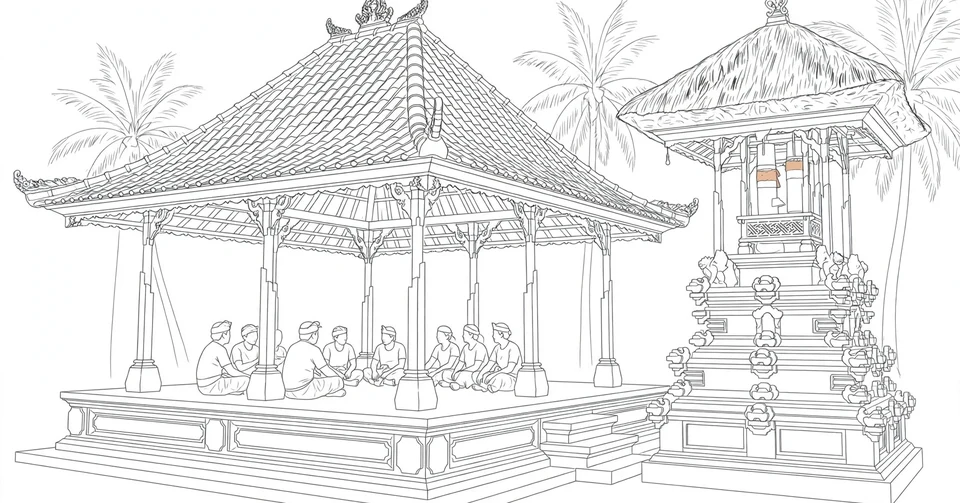
Visitors rarely notice it at all, which is part of the point. There is no signboard, no office hours, and no website. What there is, in almost every neighbourhood, is an open pavilion with a tall roof, a drum tower beside it, and a notice board that matters more than any government circular. That pavilion is the bale banjar, and the drum in its tower is the slit log that has called Balinese villagers together for centuries.
What a banjar actually is
A banjar is a social unit built on territory. The families who live in one stretch of land, one dusun or hamlet, belong to the same association, and what binds them is not only the address they share but the customs and the sacred ceremonies they perform together. One account of Balinese community life describes it as a social unity strengthened by custom unity and sacred religious ceremonies, and that order of words matters: the land comes first, the rules second, and the gods are never far behind either of them.
The word itself tells the same story. Banjar originally meant a row of houses, the clustering of family compounds into a neighbourhood with its own temple and its own community. A banjar today usually holds somewhere between fifty and two hundred family compounds, and the size alone explains why the institution feels less like a council and more like an extended family that happens to have a budget and a set of laws. Everyone in it knows everyone else, or at least knows their parents, and that familiarity is the whole machinery.
Membership follows marriage, not residence alone. The basic unit of the association is the pekurenan, the married couple, and only married couples are full members, with the full rights and the full obligations that membership carries. A young man who marries is summoned to join the association, and from that day the community has a claim on his time and his money, and he has a claim on the community in return. The rule is strict in the mountains, where membership is often limited to those born in the banjar territory, and looser on the plains, where newcomers who settle in the area are welcomed to join if they wish. The difference says something honest about Bali: the institution is old and firm, but it is not frozen, and it has always known how to bend without breaking.
That bending is visible in the cities now. The neighbourhood was once strictly territorial, a patch of land with clear edges, but in modern Bali many banjars have split, and two banjars can occupy the same territory while their members live far from the centre of community life. In densely populated areas such as Denpasar and Kuta there are many banjars, and they do not always get along, especially when residents choose to leave one banjar for another. The map of a modern Balinese town is therefore not a tidy patchwork but a tangle of loyalties, and the tangle itself is proof that the banjar is still alive enough to argue over.
The bale banjar is where Bali happens
Every neighbourhood has a centre, and the centre is a building. The bale banjar is an open pavilion, usually easy to spot from the street: a large tree nearby, two slit logs hanging from the branches, and a small shrine or two standing guard. This is where the association meets to discuss important issues, and it is also the community meeting place in the plainest sense, the spot where people gather because there is nowhere else they would rather be. Banjar means neighbourhood, and the pavilion is where that word stops being an abstraction and becomes a roof.
The bale banjar is a working building, not a monument. At the pavilion, everyone takes a turn at cooking, cleaning and performing menial duties, and the association even runs its own system of lending locals money for equipment, a small communal bank for the tools a household cannot afford alone. The rhythm of the place is set by the kulkul in its tower, the slit drum whose different beats call the members to a meeting, to a ceremony, or to an emergency, and the sound is the closest thing a banjar has to a public address system. A villager who hears it does not need to be told what it means. He has heard it all his life.
What strikes me about the bale banjar is how little it asks of the outside world. It has no staff, no budget line in a ministry, and no marketing department. It is a roof, a floor, a kitchen, and a drum, and from those four things a whole neighbourhood governs itself. Modern institutions spend fortunes trying to manufacture the sense of belonging that the pavilion produces with timber and thatch, and the difference is not the architecture. It is that the building belongs to the people who use it, and they know it.
Who runs a banjar
The neighbourhood is led by a kelian banjar, a headman elected by the members for a set period of duty. His work covers the social life of the neighbourhood and its religious life, and he is also the person who has to solve problems of custom when they arise. The election itself carries an old idea of legitimacy: the leader is chosen by the members and approved by the gods through a spiritual medium, which means his authority comes from two directions at once, from below and from above, and neither is enough on its own.
In practice there are often two heads rather than one. The kelian dinas handles the administrative side of neighbourhood life, while the kelian adat looks after the customary and religious side in collaboration with the bendesa adat, the head of the customary village. The two usually work together, and sometimes the two roles are held by one person. The split is a neat picture of how Bali runs itself: one hand holds the paperwork, the other holds the tradition, and both hands belong to the same body.
Decisions are made by the sangkep, the assembly of the male members known as the krama banjar, which often meets every thirty five days. The meetings are conducted in Basa Bali, the Balinese language, and the decisions are taken on the basis of unanimous agreement, not majority rule. That is a slow way to decide anything, and it is also the reason the decisions stick. A vote can be lost and forgotten by the next morning, but a consensus reached in a room full of your neighbours, in your own language, under the roof of your own pavilion, is a promise you made to people you will see again tomorrow.
The Indonesian government recognised the neighbourhood council in 1979 as the lowest administrative structure of the national administration, fitting in directly under the authority of the village head. The recognition matters, but it did not create it. It simply admitted that the state had found something already working at the bottom of the ladder, and had the sense to leave it there.
What a banjar does all day
The list of a banjar's jobs reads like the job description of a small town council, a court, a church committee and a social club folded into one. It acts as adjudicator of adat, traditional law, and determines dates for religious events, collects money for ceremonies, allocates temple maintenance, oversees land sales and on occasion hands out summary punishment to troublemakers. Nothing about that list is ceremonial. Every item is a real power over real lives, exercised by neighbours over neighbours, and accepted because the people exercising it are the same people who will share the consequences.
Much of that work is invisible until it is needed. It has an association called the banjar suka duka, the association for the sharing of joy and pain, which organises the social services and the communal work known as ayahan. Every member has responsibilities in helping to keep the temple clean, preparing for ceremonies, and providing funds and offerings. The responsibilities are among the most important in the whole network of village associations, and a Balinese who does not take part can be ejected from the neighbourhood. The punishment is quiet and total, and it is the reason the system works: to lose it is to lose the people who would have carried your father's body to the cremation ground.
It also looks after the practical business of the neighbourhood. It organises the pecalang, the traditional guards in black and white checked cloth who keep order at ceremonies and direct traffic when a procession fills the road. During religious events it decides which streets are blocked off, and the pecalang enforce it. The banjar also shelters the organisations that live under its roof, including the sekaa teruna, the youth organisation that builds the ogoh ogoh for Nyepi and staffs almost every ceremony it holds. The young people are the association's workforce, and it is the reason they have somewhere to belong before they marry and become full members themselves.
A banjar under the desa adat
It does not stand alone. Above it sits the desa adat, the customary village, and the two are bound together by temples and by law. A desa adat is a village that governs itself, and the neighbourhood is the unit that makes that self government real at street level. The customary village is headed by the bendesa adat, and its highest authority is the assembly of its members, but the daily work of the village is divided among its banjars, each one taking its turn.
The division of labour is visible at festival time. Much of the ritual work at the village level is shared among the various banjars: one neighbourhood may look after the pura desa, the village temple, for the coming festival, and another for the one after. Before most ceremonies can take place, a pejati, a notification offering, must be made at the kahyangan tiga, the three village temples. The pura puseh, the temple of origin, stands towards Gunung Agung; the pura desa stands at the centre of the village, where the assembly meets; the pura dalem, the temple of the dead, stands towards the ocean. Each banjar also has its own temple, the bedogol or pura banjar, with its own calendar of festivals, so the year is a relay race of obligations passing from one neighbourhood to the next.
The contrast with the subak is worth noting, because the two institutions divide Bali between them. The association governs the inhabited land, the houses and the people in them, while the subak governs the sawah, the rice fields, deciding when a farmer may flood his fields and controlling the water on which the whole island depends. A Balinese farmer therefore lives under two systems at once, one for his home and one for his fields, and both are older than the government that now recognises them. It is a tidy arrangement, and it has lasted because neither system tries to do the other's job.
The banjar in the modern city
It has survived the twentieth century and the twenty first, but survival has not been free. In the tourist towns of the south, where land is expensive and newcomers arrive every year, the old territorial logic strains. Members live far from the pavilion, some banjars have split into pieces, and the question of who belongs where is no longer settled by geography alone. The institution adapts, as it always has, but adaptation leaves marks, and the marks are worth looking at honestly.
Yet it has also shown, more than once, that it is still the strongest organisation on the island when things go wrong. One long running account of Balinese village life notes that during the riots of 1999, the banjar of Kuta patrolled its own streets to keep rioting youths from destroying tourist infrastructure. The same account records that a neighbourhood in Seminyak once decided to close down all the bars and nightclubs in its area for a weekend, to make a point, and they stayed closed. The point was made. No police order was needed, and no court was involved. The council spoke, and the neighbourhood obeyed, because the association is the neighbourhood.
That authority also has a protective side that outsiders rarely see. It is the main force that prevents the Balinese from becoming a disenfranchised population in their own homeland. It insists that locals are used for construction and hired as staff, and it watches who profits from the land inside its boundaries. In an island where tourism has made land the most valuable thing anyone owns, a body that can say no to an outsider, and make the no stick, is not a quaint survival. It is a form of power, and the Balinese know exactly what it is worth.
Why a banjar still holds
I keep coming back to a simple observation: it asks for something that modern institutions almost never ask for, which is presence. It does not want your opinion in a survey or your money in a fund. It wants your body at the pavilion on the appointed day, your hands on the cooking pots, your voice in the assembly, and your shoulder under the cremation tower when a neighbour dies. Presence is a harder demand than payment, and it is also a fairer one, because it cannot be bought, delegated, or faked. A rich man and a poor man carry the same weight at a banjar meeting, because the currency is showing up.
That is why it has outlasted every government that has tried to organise Bali from above. Kingdoms rose and fell, the Dutch came and went, the republic arrived with its ministries and its forms, and through all of it the banjar kept meeting under its roof, kept beating its drum, and kept burying its dead together. The secret is not complicated. Before there was a desa adat there were neighbours, and before there were neighbours there was a row of houses that decided to look after one another. The banjar is that decision, renewed every thirty five days, in a language only the members speak, under a roof they built themselves. Bali is lived in the neighbourhood long before it is governed anywhere else, and as long as the pavilion stands and the drum still sounds, the island will keep its own shape.
More in Culture & Society
- Suka Duka Means the Banjar Shows Up for Joy and Grief Alike
- Tabuh Rah Spills Blood So the Ground Stays Calm
- The Bendesa Adat Speaks for a Village That Has Two Governments
- Catur Brata Is Four Silences Kept at the Same Time
- Your Weton Is the Day You Were Born, Counted Two Ways
- Rahu and Ketu Still Chase the Sun and Moon Across the Sky
Latest posts
- On Koyasan the Founder Is Said to Be Still Meditating
- Hiwatari Asks You to Walk Across the Fire
- Ngembak Geni Is the Morning Bali Starts Talking Again
- Karang Ayahan Is the Plot of Land a Village Trusts You With
- On Tumpek Landep Bali Blesses Everything Made of Metal
- Sudachi Is the Sharpest of Japan's Sour Citrus
- Shugendo Turns a Mountain Into a Place of Testing
- A Canang Sari Is Made Fresh Every Morning and Gone by Night
- The Aling-Aling Wall Exists Because Spirits Walk in Straight Lines
- Oi-Nishin Sent Tohoku Farmers Chasing Herring Every Spring
- The Nishin Goten Were Palaces Paid for by Fish
- The Tobi Were Edo's Daredevils Before They Were Its Firemen
- Kabosu Is Oita's Gentle Answer to Yuzu
- A Yamabushi Trains Where the Mountain Is the Temple
- Tri Hita Karana Holds a Village in Three Balances