The Paruman Decides Everything by Talking Until Everyone Agrees
· 14 min read
A paruman is the village assembly of a Balinese desa adat, where the krama households gather to decide the village's rules, money, ceremonies and disputes by consensus, and where a decision only counts when everyone in the room can live with it.
In a Balinese customary village, nothing important is decided by one person alone. Not the date of a temple festival, not the repair of a temple wall, not the punishment of a neighbour who broke the rules, and not the appointment of the officers who run the village. Every one of those decisions belongs to the paruman, the village assembly, and the paruman decides by talking until everyone in the room agrees.
A paruman is the meeting of the krama, the full member households of a desa adat, gathered to settle the business of the village together. It is the highest forum of the customary village, the place where the rules are written, the money is accounted for, the officers are chosen, and disputes are argued out in front of the whole community. The word itself comes from paum, an old word for meeting or convening, and the meeting has been the engine of Balinese village life for longer than any written record of it.
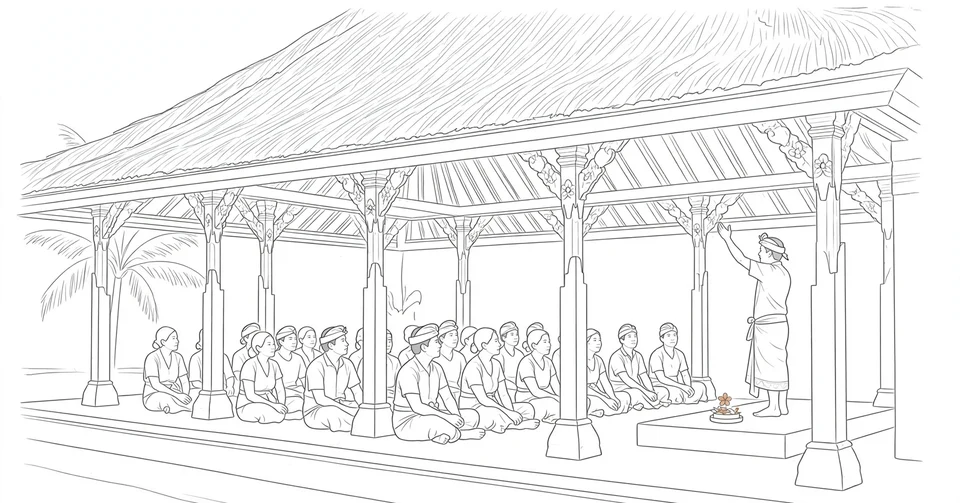
What makes a paruman different from a council meeting or a parliament is not the agenda. It is the standard of agreement. A paruman does not count votes to find a winner. It talks until the room reaches mufakat, a consensus every household present can accept, and only if that fails does it fall back on a majority vote. The measure of a good paruman is not how fast it ends. It is whether everyone walks home with a decision they can live with.
What a paruman actually is
A paruman is the assembly of a desa adat, the customary village that governs temple life, ceremony, land and custom in Bali. The desa adat runs beside the state's administrative village, and in daily life its voice is usually the louder one, because it is the institution that organises the ceremonies, maintains the temples and settles the disputes that shape a Balinese year. The paruman is where that institution does its thinking out loud.
The assembly belongs to the krama. Each krama household sends its head to sit in the meeting, so the room is a gathering of households rather than of individuals. In the highland Bali Aga village of Sukawana, the assembly counts 740 male members, and each one stands for a household, a hearth the Balinese call a kuren. A man joins only after he marries, when the marriage ritual is complete, and his name enters the village register. From that day his rank among the other members is fixed by the date he joined.
That household logic is the same across the island, even where the details differ. The formal seat in the paruman belongs to the household and is usually held by its head, while women carry their own ritual roles in the temple and the community. The rules differ from village to village, and any honest account has to say so. What does not differ is the principle: the village counts households, and every household is represented when the village decides.
The paruman is also where the village's officers answer for their work. The prajuru adat, the board of customary officers chosen from within the community, run the village between meetings, and at the paruman they must report on how they have run it. The meeting opens with a prayer, the officers give their account, and then the room takes up its business. A krama does not only obey the village. A krama helps to decide what the village does, as I wrote in Krama Is What Makes You a Full Member of the Village.
Who sits in the circle
The people in the room are the people who will have to carry out whatever is decided, and that is the point. A paruman is not a body of representatives sent away to decide on behalf of absent strangers. It is the village itself, sitting in a circle in the bale agung, the great pavilion, or in the village temple, working through its own affairs face to face.
At the front of the meeting sit the prajuru, led by the bendesa adat, the customary village head. Beside them sit the elders whose memory of past decisions steadies the discussion, and the kelian of each banjar, the neighbourhood wards that make up the village. The kelian carry the views of their own banjar meetings into the larger room, and they carry the paruman's decisions back to their neighbourhoods afterwards. The chain runs both ways, and it is what makes a decision taken in the pavilion into a decision the whole village actually follows.
Not everyone who lives in the village sits in the paruman. Guest members, the krama tamiu, are protected by the village and share in its joys and sorrows, but the formal voice in the assembly belongs to the full krama households. In the Bali Aga villages the line is drawn further, with newcomers and landless sharecroppers holding a marginal status and excluded from formal decision making, a rule the villages are frank about: newcomers must not be able to take control of the village by outnumbering its old families. The circle is generous in some directions and guarded in others, and it has always been both.
I find that honesty refreshing, even when it is uncomfortable. A paruman does not pretend to be a universal parliament. It is a meeting of the households that have bound themselves to the village, its temple, its land and its obligations, and it is those households that decide. The village does not hide that boundary. It writes it into the awig-awig, the customary code, for anyone to read.
How a paruman reaches a decision
The procedure of a paruman is simple to describe and hard to practise. The meeting opens with a prayer. The officers report. Then the matter is put to the room, and everyone who wishes to speak may speak. The discussion continues until the room finds a position that all can accept, and only then is the decision taken.
One village's written code sets the rules out plainly. The revised awig-awig of Desa Adat Bale Agung Kerambitan in Tabanan requires more than half of those who should attend before a meeting can proceed, seeks decisions by consensus, and allows a majority vote only if consensus cannot be reached. That order matters: the vote is a fallback, not the method. The first prize is agreement, and the room is expected to work for it.
The same instinct runs through the smaller meetings of the banjar, the neighbourhood ward. A travel guide to Balinese village life notes that decisions in the banjar's assembly, the sangkep, are taken on the basis of unanimous agreement, unlike the western ideal of winner takes all, and that the sangkep often meets every 35 days. The 35 day rhythm follows the Balinese calendar, and it means the neighbourhood is in the habit of talking things through several times a month, so that by the time a matter reaches the paruman, the arguments have already been rehearsed at home.
The point of all that talking is not elegance. It is repair. A study of the sangkep tradition in Buyut Baru village found that disputes are settled by what the researchers call the principle of completeness: the settlement is designed so that the parties can still continue living together as they were before the problem occurred. The goal is to restore peace and harmony in the relationships that existed before, between the parties and within the wider community, rather than to declare a winner and a loser. The same study found that every citizen in the meeting is given the opportunity to give an opinion, and that the decision is then taken by consensus. A paruman is a court, a parliament and a family conference at once, and it judges its own success by whether the village is still whole when the meeting ends.
What the paruman decides
Almost everything the desa adat does passes through the paruman at some point. The assembly writes and revises the awig-awig, the village's own rulebook, which sets out who belongs, what they owe, what is forbidden and what happens to those who break the rules. It fixes the calendar of ceremonies and the division of labour between the banjar, deciding which ward looks after the village temple for one festival and which takes the next. It approves the use of village money, including the profits of the village credit institution, the LPD, which flow back into ceremonies, temple work and communal projects. It settles disputes between neighbours and decides the sanctions for offences, up to kasepekang, the cutting off of a household from the village's help.
That last power is the one that shows what a paruman really is. A study of customary justice in the desa pakraman found that the customary court settles every case submitted to it through a deliberation mechanism in a meeting named Paruman Prajuru, the deliberation of the officers, and that the institution carrying out the function, called Kertha Desa, consists of the customary chiefs together with other village officials. A study of one village, Saraseda, found that customary cases were resolved by the village officers through the paruman, described as the highest consensus institution in the village's deliberations, and that the sanctions imposed included sangaskara danda, the customary penalty. The paruman is not only a talking shop. It is the village's court, and its verdicts are carried out by the community itself.
The paruman also appoints the people who carry the village's work. The pecalang, the village guards who keep order at ceremonies, are appointed through the assembly, and so are the officers of the prajuru. The meeting is where authority is given, and it is where authority is taken back, because an officer who has lost the room's confidence will hear about it at the next paruman, in front of everyone.
The range of the agenda is what makes the paruman feel less like a committee and more like a government. A desa adat is a real government in its own right, running in parallel with the state village, and the paruman is its legislature, its court and its public meeting rolled into one. Bali counts about 1,500 customary villages against 636 administrative ones, and each of them has its own assembly deciding its own affairs, as described in A Desa Adat Is a Village That Governs Itself. Provincial Regulation Number 4 of 2019 recognised the desa adat in law as an autonomous legal community, but the paruman did not need the regulation to exist. It had been deciding everything for centuries before the regulation was written.
Paruman and sangkep, two meetings with one habit
Visitors to Bali sometimes meet two different words for what looks like the same thing, and the confusion is understandable. The village assembly is the paruman. The neighbourhood assembly of the banjar is the sangkep, also called pesangkepan. A paper on the sangkep tradition explains the two words plainly: pesangkepan comes from the basic word sangkep, while paruman comes from the basic word paum, and both contain the same meaning, namely meetings, to convene, or to conduct meetings.
The difference is scale, not spirit. The sangkep of the banjar meets often, sometimes every 35 days, and handles the affairs of one neighbourhood: its temple, its ceremonies, its collections, its small disputes. The paruman of the desa adat meets less often and gathers the whole village, and it handles the matters that belong to the village as a whole: the awig-awig, the great temple festivals, the village money, the serious disputes, the appointments. The sangkep feeds the paruman, because the kelian bring their neighbourhood's views upward, and the paruman feeds the sangkep, because the decisions taken in the great pavilion are carried back down to be put into practice street by street.
Both meetings run on the same habit, and the habit is the real subject of this article. The habit is deliberation to reach consensus, practised so often that it becomes a way of thinking. The same paper found that the sangkep plants values in its participants without them noticing: discipline, gotong royong, independence, the courage to express an opinion, mutual respect, tolerance, and always consulting. People learn to receive any idea and argument from each participant, to speak without fear, and to weigh the opinions of everyone present before a decision is made. The meeting is a school as much as a government, and its graduates are the villagers themselves.
There is a historical depth to the word that is worth noting. In older court practice, rulers assembled deputies and office holders at meetings called paruman agung, great assemblies, whenever matters of public concern needed to be discussed. The word that now names a village meeting once named the gathering of a kingdom's deputies, and the scale changed while the idea did not: bring the people who must live with a decision into the room, and do not leave until the decision is one they can carry.
Why slowness is the point
It is easy, from outside, to call the paruman inefficient. A meeting that talks until everyone agrees will always be slower than a meeting that counts hands at the first sign of disagreement. A village that needs more than half its households present before it can even begin will sometimes wait weeks for a decision that a single official could have taken in an afternoon. The criticism is not wrong about the speed. It is wrong about what speed is for.
A paruman is slow because its decisions have to be carried out by the very people who made them, with their own unpaid labour, their own money and their own standing in the community. A decision imposed on a dissenting minority in such a village does not end when the meeting ends. It festers in the banjar, it is remembered at the next temple festival, and it returns as a dispute at the following paruman. A decision everyone agreed to, even reluctantly, is carried out by the whole village the next morning, because nobody in the room can say the decision was forced on them. They were there. They spoke. They stayed until the talking produced something they could accept.
That is the bargain the paruman offers, and it is the same bargain that runs through the whole desa adat. Membership is demanding: unpaid work, contributions, presence at ceremonies, year after year. In exchange the member gets a voice, a temple, a piece of land and a community that will bury its dead. The paruman is where the voice is exercised, and the voice is worth having precisely because the decisions it produces are decisions the village will actually keep.
The pressure on the habit is real, and it would be dishonest to pretend otherwise. Young villagers work in Denpasar or overseas and cannot always attend. Meetings compete with jobs, school runs and phones. Some villages now announce their paruman in chat groups, and the announcements sit beside holiday photos and football scores. But the meeting itself has not changed its shape: the prayer, the report, the open floor, the long search for a position everyone can accept. A chat group can call a meeting. It cannot replace the room where the village looks at itself and decides what it will do.
A paruman decides everything by talking until everyone agrees, and the talking is not a delay before the decision. The talking is the decision. When the room finally falls quiet and the bendesa adat reads out what has been agreed, the village has not merely chosen a course of action. It has rehearsed, in public, the fact that it is still one village, capable of disagreeing without breaking apart. That is a slower kind of democracy than the one that counts votes and moves on, and it is a stronger one for the purposes it serves. It does not ask how quickly a village can decide. It asks whether the village can still live together afterwards, and it answers that question, meeting by meeting, in the only way that has ever worked: by staying in the room until everyone agrees.
More in Culture & Society
- Suka Duka Means the Banjar Shows Up for Joy and Grief Alike
- Tabuh Rah Spills Blood So the Ground Stays Calm
- The Bendesa Adat Speaks for a Village That Has Two Governments
- Catur Brata Is Four Silences Kept at the Same Time
- Your Weton Is the Day You Were Born, Counted Two Ways
- Rahu and Ketu Still Chase the Sun and Moon Across the Sky
Latest posts
- On Koyasan the Founder Is Said to Be Still Meditating
- Hiwatari Asks You to Walk Across the Fire
- Ngembak Geni Is the Morning Bali Starts Talking Again
- Karang Ayahan Is the Plot of Land a Village Trusts You With
- On Tumpek Landep Bali Blesses Everything Made of Metal
- Sudachi Is the Sharpest of Japan's Sour Citrus
- Shugendo Turns a Mountain Into a Place of Testing
- A Canang Sari Is Made Fresh Every Morning and Gone by Night
- The Aling-Aling Wall Exists Because Spirits Walk in Straight Lines
- Oi-Nishin Sent Tohoku Farmers Chasing Herring Every Spring
- The Nishin Goten Were Palaces Paid for by Fish
- The Tobi Were Edo's Daredevils Before They Were Its Firemen
- Kabosu Is Oita's Gentle Answer to Yuzu
- A Yamabushi Trains Where the Mountain Is the Temple
- Tri Hita Karana Holds a Village in Three Balances