Soto Soup and How Indonesia Makes Its Favourite Bowl
· 8 min read
Soto soup is Indonesia's turmeric-yellow comfort in a bowl, with dozens of regional versions from Lamongan to Jakarta. Here is what goes into the bowl, what makes each version different, and how to order it like a local.
Order a bowl of soto soup in Indonesia and you are not really ordering one dish. You are ordering a map. The broth, the meat, the toppings and the small dishes lined up beside the bowl all point to a place, a history and a way of eating that belongs to one town and nowhere else.
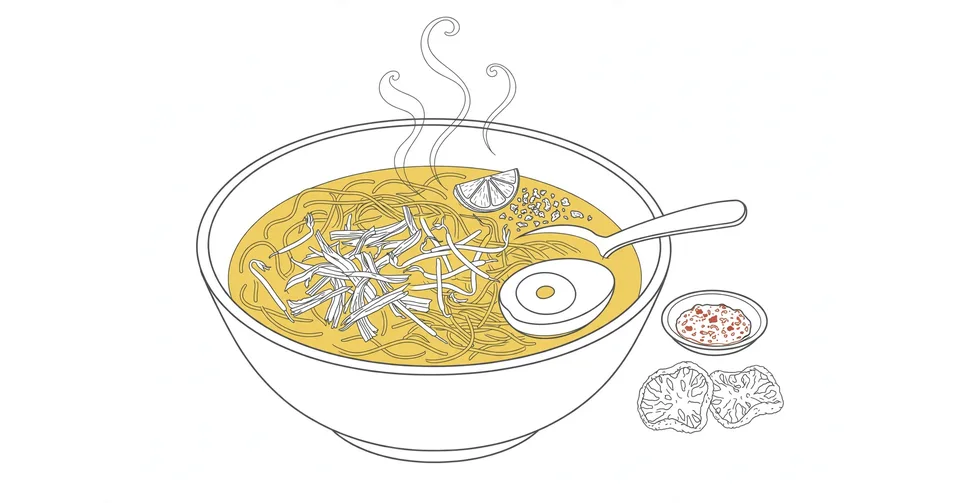
At its simplest, soto soup is a spiced broth with meat, served hot with rice or rice cake and a crowd of condiments. The broth is usually golden from turmeric, the meat is chicken or beef, and the bowl arrives with bean sprouts, vermicelli, a boiled egg, fried shallots and a wedge of lime. What changes from town to town is almost everything else.
Ask an Indonesian to name the best soto soup and you will start an argument that never ends. Everyone has a hometown version, and everyone is sure it is the right one. That argument is the point. Soto soup is not one recipe. It is a family of recipes, and the family is enormous.
How Soto Soup Became Indonesia's National Dish
The word soto itself tells the story. Researchers trace it to the Hokkien words cao du, which described spiced offal, and the dish arrived in Java with Chinese traders and settlers. In the 19th century, Semarang on the north coast of Central Java became one of the first places where soto was sold as street food, and from there it spread across the island and then the whole archipelago.
A study published in the Journal of Ethnic Foods in 2020 counted 75 distinct forms of soto soup across Indonesia, distinguished mostly by their broth and their herbs. A CNN survey in 2011 had already named 40 varieties. In 2018 the Indonesian government named soto one of the country's five national foods, alongside rendang, satay, fried rice and gado gado. It was the only one of the five that is really a whole category of dishes wearing one name.
That history explains why soto soup feels both foreign and deeply Indonesian. Chinese traders brought the idea of a spiced soup, Indian and Arab traders brought spices, and Javanese cooks made it their own with local herbs, turmeric and the habit of eating it with rice. Every region then bent the recipe to what it had.
What Goes Into a Bowl of Soto Soup
Every bowl of soto soup is built the same way, in layers. First comes the broth, simmered with a spice paste of garlic, shallots, turmeric, ginger, lemongrass and candlenuts. Then the meat, usually shredded chicken or chunks of beef, cooked in the broth until tender. Then the fillers: rice vermicelli, bean sprouts, cabbage, and a hard boiled egg cut in half.
The last layer is the one that makes soto soup personal. Fried shallots, chopped celery, a squeeze of lime, a spoonful of sambal and a dash of sweet soy sauce all sit on the table, and each person seasons the bowl to taste. Crackers come with almost every bowl, whether shrimp crackers, emping or the flat yellow crackers called kerupuk, and many stalls sell satay and fried potato cakes on the side.
| Part of the bowl | What it usually is |
|---|---|
| Broth | Spiced stock, golden from turmeric, clear or creamy |
| Meat | Shredded chicken, beef, offal or buffalo |
| Fillers | Rice vermicelli, bean sprouts, cabbage, boiled egg |
| Seasoning | Lime, sambal, sweet soy sauce, fried shallots, celery |
| Crunch | Shrimp crackers, emping or kerupuk |
The rice question is the first choice a newcomer has to make. In many places the rice comes in a separate bowl, so you can spoon it in as you eat. In others, the rice or a compressed rice cake called lontong or ketupat goes into the soup from the start. There is no wrong answer, and regulars will tell you their way is the only way.
Soto Lamongan and the Crunch of Koya
If one version of soto soup has travelled furthest from home, it is the one from Lamongan, a town in East Java. Soto Lamongan is a chicken soup with a clear, golden broth, shredded chicken, vermicelli, cabbage, bean sprouts and a boiled egg. What sets it apart is a powder called koya.
Koya is made from shrimp crackers and fried garlic, ground together into a fine powder. The vendor sprinkles it over the bowl just before serving, and it melts into the broth while keeping a faint crunch. It adds a savoury depth that no other version of soto soup has, and Lamongan vendors guard their koya the way other cooks guard a family recipe.
Soto Lamongan is also the version most Indonesians meet first, because Lamongan stalls are everywhere, from Jakarta street corners to small towns in Sumatra. It is the default soto soup, the one people mean when they say the word without adding a place name.
Soto Betawi and the Creamy Exception
Jakarta's version breaks the rules. Soto Betawi is made with beef and offal, simmered in a broth of coconut milk and cow's milk until it turns creamy and pale. Potatoes and tomatoes go into the bowl, emping crackers and pickled vegetables sit beside it, and the whole thing is richer and heavier than any other soto soup.
One popular story credits the dish to a street vendor named Lie Boen Po, who sold it from a cart in Jakarta in the early 20th century, when the city was still called Batavia. Whether or not the story is exact, the dish fits its city. Jakarta has always been a meeting place of Chinese, Arab, Indian, Dutch and Betawi cooking, and soto Betawi tastes like all of them at once.
The milk is the point. Most soto soup is clear and light, the kind of food you eat for breakfast. Soto Betawi is a meal in itself, and Jakarta eats it at any hour, usually with a plate of steamed rice and a glass of iced tea.
Soto Madura, Soto Kudus and Soto Banjar
Madura, the island off the north coast of East Java, makes its soto soup with beef. The broth is yellow and heavily spiced, the bowl holds bean sprouts, rice noodles and fried potato slices, and each of the island's four regencies, Bangkalan, Sampang, Pamekasan and Sumenep, has its own small variation. It is a beef soup for a cattle island, and the flavour is bolder than the chicken versions of Java.
Kudus, a town in Central Java, serves its soto soup in small bowls. The broth is clear and light, the meat is shredded chicken, and the portions are deliberately modest, so regulars often order a second bowl. The original version used buffalo meat instead of beef, a choice traced to Sunan Kudus, one of the nine saints who spread Islam in Java, who replaced beef out of respect for the town's Hindu neighbours. Outside Kudus, chicken has become the usual meat, and stalls line the bowl with little satay skewers of offal, quail eggs, tofu and tempeh.
Soto Banjar comes from South Kalimantan, and it tastes of the spice trade. The chicken broth is seasoned with cinnamon, cloves, cardamom and nutmeg, and it is served with ketupat, the compressed rice cake wrapped in woven palm leaves, plus vermicelli, boiled egg and potato cakes. It is the farthest east of the famous versions, and the spices give it away.
How to Order Soto Soup Like a Local
Ordering soto soup is easy once you know the routine. Choose the version by its place name, decide whether the rice goes in the bowl or beside it, and then season the bowl yourself. Lime first, then sambal, then a little sweet soy sauce. Taste, and adjust. Nobody seasons your bowl for you, and that is half the pleasure.
Eat it the way most Indonesians do, for breakfast or lunch, at a stall with low plastic stools and a pot that has been simmering since dawn. The best soto soup is rarely found in a restaurant with a printed menu. It is found where the broth has been going all morning and the regulars have been coming for years.
If you are travelling in Indonesia, treat soto soup as a way to read each town you pass through. A clear broth in one place, a creamy one in the next, chicken here, beef there, ketupat instead of rice. Each bowl is a small history lesson, served steaming hot, and the lesson changes every time you cross into a new town.
What I like most about soto soup is that it refuses to be standardised. In a world where the same fast food tastes identical in every country, Indonesia keeps a soup that changes its mind in every town, and every town is proud of the difference. The best bowl is never the one in the guidebook. It is the one your neighbour swears by, eaten shoulder to shoulder with strangers who all agree on one thing, that their town makes it best.
More in Food & Travel
- Katsuobushi Is a Fish You Shave Like a Block of Wood
- Why Kagami Mochi Is Never Cut With a Knife
- Narazuke Pickles Spend Years Asleep in Sake Lees
- Tomozuri Sends a Living Fish to Do the Fishing
- Dashi, the Quiet Stock Under Almost Everything Japan Cooks
- Ayu, the Sweetfish That Rules Japan's Clear Rivers
Latest posts
- Urashima Opened the Tamatebako and Time Came to Collect
- How Supersemar Borrowed the Authority of a God
- Bali Has Its Own Semar, and His Name Is Twalen
- White Silk Means You Made It as a Sekitori
- The Dohyo-Iri Gives a Yokozuna Three Minutes to Own the Ring
- Nobody Commutes to a Heya
- Tokyo Keeps a Hundred Tiny Fujis Called Fujizuka
- One Thousand Three Hundred Years of Ukai Nights on the Nagara River
- Fuji Ko, the Pilgrim Societies That Climbed Mount Fuji Together
- Gensen Kakenagashi, the Onsen Water That Never Circles Back
- Shiko, the Leg Stamp That Starts Every Sumo Day
- Semar, the God Who Chose to Work as a Servant
- Kyushoku and the Japanese School Lunch
- Sumadori, Japan's Smart Drinking for People Who Do Not Drink
- Sake Kasu, the Sake Lees Japan Cooks With Instead of Throwing Away