The Obon Festival, Japan's Week for Honouring Ancestors
· 10 min read
The Obon festival is the week in August when Japan honours its ancestors and the whole country travels at once. Here is what happens, and how visitors can take part.
Every August, Japan slows down and turns its attention to the dead. The Obon festival is the week when families believe the spirits of their ancestors return to visit, and when the whole country moves at once to welcome them. Trains fill up, highways jam, and villages that are quiet all year suddenly fill with returning families.
Obon is not a festival of fireworks and parades, though it has dancing and lanterns. At its heart it is a family occasion, closer to a reunion than to a party. The graves are cleaned, the lanterns are lit, and for a few days the living and the dead are meant to be together again.
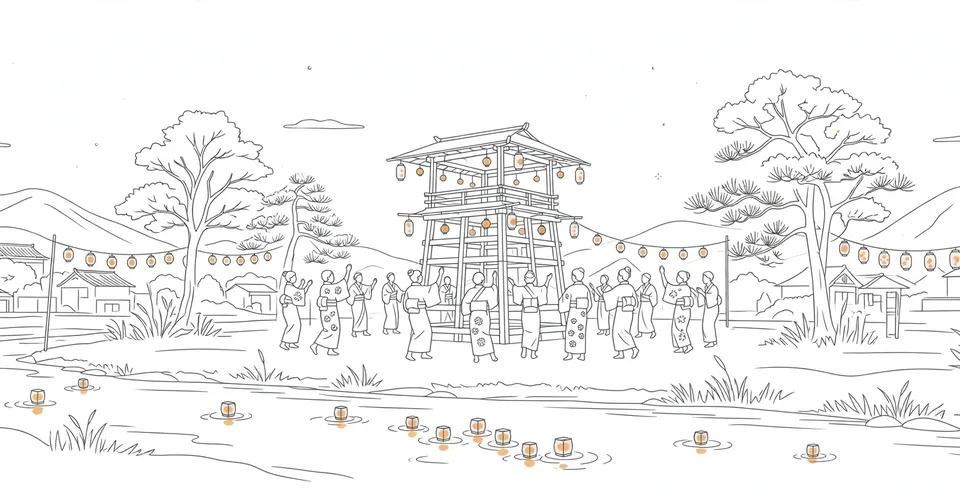
The Obon festival is also one of the best weeks of the year for a visitor to see Japan outside its working hours. The dancing is open to anyone, the lanterns are beautiful, and the mood is warm rather than solemn. You do not need an invitation. You only need to know what is happening and how to join in respectfully.
What the Obon festival is
The Obon festival, short for Urabon-e, is a Buddhist observance that has become one of Japan's biggest annual events. In most of the country it is held in mid-August, around 13 to 16 August. Some regions, including parts of Tokyo and the old capital cities, observe it a month earlier, in July. The dates differ, but the meaning is the same everywhere.
The belief behind the Obon festival is simple. For a few days each summer, the spirits of ancestors leave the world of the dead and return to the homes of their families. The living prepare for their arrival, spend time with them, and then send them back with light and ceremony. It is a visit, not a haunting, and it is treated with affection rather than fear.
The festival has Buddhist roots, but in practice it belongs to everyone. People who never visit a temple the rest of the year still go home for Obon, still clean the family grave, and still light the lanterns. It is less a religious duty than a family habit, passed down through generations, and it survives because it answers a real need: a fixed moment in the year to remember the people who came before.
The week the ancestors come home
The Obon festival begins with preparation. Families clean their homes and set up a small altar, called a shoryodana, with offerings of fruit, rice, flowers, and the favourite foods of the dead. A lantern called a chochin is hung at the entrance, to guide the spirits home through the dark.
The most important act of the Obon festival is ohaka-mairi, the visit to the family grave. Families travel to the cemetery, wash the gravestone, clear the weeds, and leave fresh flowers, water, incense, and food. It is ordinary, physical work, done together, and it is the part of Obon that most Japanese people actually do.
On the first evening, a small fire or lantern called a mukaebi, a welcoming fire, is lit to show the spirits the way home. On the last evening, an okuribi, a sending fire, is lit to guide them back. The week opens and closes with light, and the light is the point. The dead are not summoned and dismissed. They are welcomed and farewelled, like guests.
Bon Odori, the dance everyone can join
The most joyful part of the Obon festival is Bon Odori, the dance of the festival. On summer evenings, communities gather in a park, a temple courtyard, or a shopping street. A raised wooden tower called a yagura stands in the middle, with drummers and singers on top. Around it, people dance in a slow circle.
The dances are simple by design. A few repeated steps, arms rising and falling, feet shuffling in a circle that never stops. They are folk dances, some of them centuries old, made so that anyone could join, including children and strangers. The dancers wear yukata, the light summer kimono, and the whole scene has the feel of a village fair.
Visitors are welcome to join the circle. Bon Odori is a community dance, and the circle is meant to be open. Watch the dancers in front of you for a few minutes first, copy their steps, and keep moving in the same direction as everyone else. Nobody will mind if your steps are wrong.
Many towns hold their Bon Odori on a single evening in August, and the dates are usually advertised on local noticeboards and city websites. If you are in Japan in mid-August, ask at your hotel or at the tourist information desk. There is almost certainly a dance within reach.
Toro Nagashi, the lanterns on the water
The Obon festival ends with Toro Nagashi, the floating of lanterns. Paper lanterns, each lit with a small candle, are set on a river or the sea and left to drift away, carrying the spirits back to the world of the dead. Hundreds of small lights moving on dark water is the quietest, most beautiful moment of the week.
The best known Toro Nagashi is held on the Sumida River in Tokyo, but smaller ones take place on rivers and coasts all over Japan. Some are organised by temples, some by neighbourhoods, and in some places families simply float a lantern of their own. The mood is gentle. People watch in silence, or speak softly, and the lanterns drift until they are out of sight.
Toro Nagashi is also the part of the Obon festival where a visitor should be most careful. The lanterns are not decorations, and the people watching them are often remembering someone specific. Stand back, keep your voice down, and let the lanterns do the talking.
The five fires of Kyoto
In Kyoto, the Obon festival ends with one of Japan's great spectacles. On 16 August, the Daimonji Gozan no Okuribi lights five giant bonfires on the mountainsides around the city. The largest and most famous is the character dai, meaning big, burned into the slope of Mount Daimonji. The other four are a second dai, a myoho (the characters for wonderful dharma), a funagata (the shape of a boat), and a torii gate.
The fires are lit at eight in the evening, one after another, and they burn for about thirty minutes. The Daimonji festival draws huge crowds to the riverbanks every year. The fires are the sending fire for the whole city, a single okuribi large enough to guide every spirit home at once.
Daimonji is not a show put on for tourists. It is a religious rite, organised by local preservation societies, and the fires are tended by families who have done the job for generations. The best viewing spots, along the Kamo River and from the hills, are public. The advice is the same as everywhere at Obon. Arrive early, expect crowds, and watch the fires the way the people of Kyoto watch them: quietly.
Why Obon is the busiest week of the year
The Obon festival is one of the busiest travel weeks in Japan, on the same scale as Golden Week. Millions of people return to their hometowns, and the trains, flights, and highways fill up. The Shinkansen between Tokyo and Osaka runs at full capacity, expressway traffic jams stretch for tens of kilometres, and flights to regional cities sell out days in advance.
That is why Obon appears in so many travel warnings. Climbing Mount Fuji in August is at its busiest in Obon week, when the trails fill with holiday climbers and the huts are booked solid. The same is true of almost every popular destination. If you plan to travel during Obon, book your transport and your rooms early, and expect crowds at every station and every shrine.
But the crowds are also the point. The Obon festival is the rare week when Japan stops working. The country has few long holidays, and the working culture is famous for long hours and short breaks. For many people, Obon is the one week of the year when they are allowed to go home. It is a week when work waits, and family comes first.
That is part of what makes the Obon festival worth seeing. It is not only about the dead. It is about the living taking a week to remember what matters, and to be with the people who matter. A visitor who joins a Bon Odori circle, or watches lanterns drift down a river, is not watching a performance. They are watching a country remember itself.
How to take part respectfully
The Obon festival is open, but it is also personal, and a little care goes a long way. The simplest rule is to follow the people around you. If they are quiet, be quiet. If they are dancing, dance. If they are cleaning a grave, leave them to it and come back another time.
At a grave, do not touch the offerings or photograph other people's families. At Toro Nagashi, do not wade into the water or try to catch a lantern. At Bon Odori, wear whatever you like, but a yukata, which can be rented in many towns in summer, is a nice gesture and will make you feel less like a spectator.
If you are invited to join a family for the Obon festival, accept. It is a genuine honour, and the best way to understand the festival. Bring a small gift, offer to help with the cleaning, and do not worry about getting the rituals right. Your hosts will guide you, and they will be glad you came.
A week to remember
The Obon festival is easy to miss if you only look at Japan's famous sights. It has no single landmark, no famous building, and no ticket to buy. It happens in cemeteries and parks, in small towns and big cities, in the same week, and then the Obon festival is gone.
But it is one of the most Japanese weeks of the year. It shows a country that is modern and busy, and yet still makes time, every summer, to clean a grave, light a lantern, and dance in a circle with its neighbours. The ancestors come home, the families come home, and for a few days the whole country is together.
If you are in Japan in mid-August, do not spend the week in a hotel room. Find a Bon Odori, watch a Toro Nagashi, and if you are in Kyoto on 16 August, watch the fires on the mountains. You will understand Japan a little better for it.
More in Culture & Society
- The Dalang, the Single Voice Behind Every Wayang Puppet
- Yadnya Kasada, the Festival That Feeds the Crater of Mount Bromo
- The 8050 Problem, When Retired Parents Still Carry Their Adult Children
- Anak Krakatau, the Child of Krakatoa That Keeps Growing
- Coelacanth and the Living Fossil of the Deep Sea
- Numazu Imperial Villa and Japan's Seaside Imperial Retreat
Latest posts
- Chankonabe, the Hot Pot That Feeds a Sumo Stable
- Koji Mold, the Quiet Engine Behind Japanese Food
- Moai, Okinawa's Lifelong Circles of Friends
- Otohime, the Small Sound That Protects Privacy in Japanese Toilets
- Yozakura, Japan's Cherry Blossoms After Dark
- Nomikai, the After-Work Drinks That Are Part of the Job in Japan
- Sakura Ebi and the Tiny Shrimp Only Suruga Bay Catches
- Senbon Matsubara and the Pine Grove of Numazu
- Shirasu and the Whitebait Bowls of Shizuoka
- Uchiura and the Quiet Fishing Village Behind Love Live Sunshine
- Love Live Sunshine and How Anime Changed Numazu
- Numazu Deep Sea Aquarium and the Creatures of Suruga Bay
- Numazu Himono and the Art of Dried Fish
- Numazu Port and the Freshest Seafood in Shizuoka
- Disaster Vending Machines in Japan That Give Their Drinks Away