Japanese Spider Crab, the Giant That Lives Off Heda
· 8 min read
The Japanese spider crab is the largest crab in the world, and the small port of Heda in Numazu City is where Japan eats it. This is the story of the giant from the deep water of Suruga Bay, and of the meal it becomes.
The Japanese spider crab is the largest crab in the world. A large male can stretch out to more than three metres from claw to claw, wider than a small car, and the record animals come close to four metres. Yet the best place to meet a Japanese spider crab is not behind aquarium glass. It is on a table in Heda, a small fishing port in Numazu City, where the giant is served for dinner.
Heda sits on the west coast of the Izu Peninsula, tucked behind a curved spit of sand, with Mount Fuji standing across the water on a clear day. The village has belonged to Numazu since 2005, and it faces Suruga Bay, the deepest bay in Japan. Just offshore, the sea floor falls away into real darkness. That depth is the whole story, because the Japanese spider crab lives down there, and Heda is the port that learned how to bring it up and cook it.
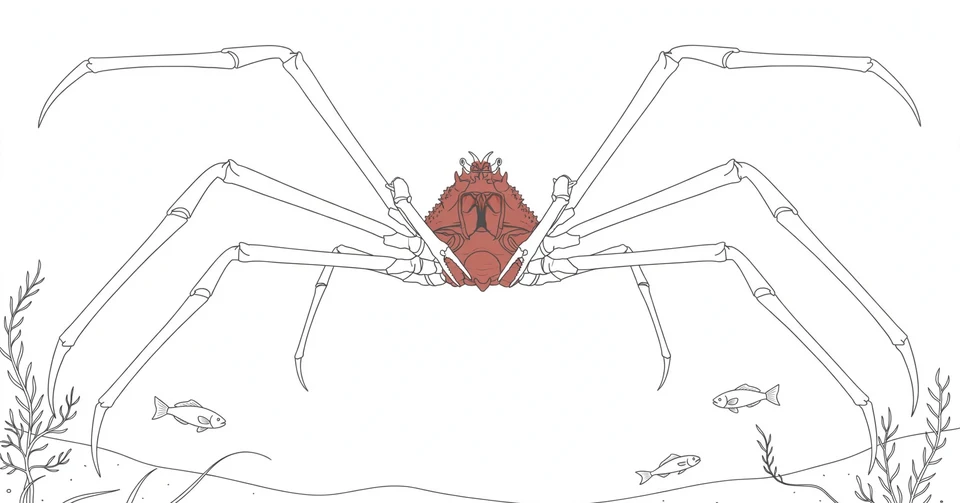
This is an animal that looks like a creature from a much older ocean, all legs and armour. In Heda, though, nobody treats the Japanese spider crab as a monster. They treat it as the most important guest of the winter table, and they have built the village's reputation on serving it well.
A Japanese spider crab is mostly legs
The Japanese name, takaashigani, says it plainly. It means tall legged crab. The body of a Japanese spider crab is almost modest, a rough, spiky carapace that grows to about 40 centimetres across, and the whole animal weighs up to 19 kilograms. Everything else is leg. Stretched out, a Japanese spider crab can reach 3.7 metres from claw to claw, the largest leg span of any arthropod on Earth. A preserved specimen at the American Museum of Natural History measures 3.8 metres across its outstretched legs.
The colour is a deep orange, with white spots along the legs, and the look is fierce. The temperament is not. The Japanese spider crab is a slow scavenger that walks the sea floor picking at dead fish, shellfish and algae. It dresses for the part, too. A Japanese spider crab sticks sponges and scraps of other sea life onto its shell until its outline blurs into the rocky floor. It was described for Western science in 1836 by the Dutch zoologist Coenraad Jacob Temminck, who named it for Engelbert Kaempfer, the German naturalist who had written about Japan more than a century earlier. It is the only living member of its genus, which is why Japanese writers so often call the Japanese spider crab a living fossil.
Deep water on the doorstep
Suruga Bay reaches about 2,500 metres at its deepest point, which makes it the deepest bay in Japan. Most bays separate a fishing port from deep water by hours of sailing. Suruga Bay does the opposite. The slope is so steep that the deep grounds begin close to shore, and the Japanese spider crab lives right there on that slope, between 200 and 500 metres down in the bay's cold, dark water. Around 300 metres down, the water sits at roughly 10 degrees Celsius all year.
Local boats work the slope with small trawl nets, hauling up whatever the deep water gives them. It gives them a lot. The bay is home to an unusual crowd of deep sea species, the same creatures that fill the tanks at the Numazu Deep Sea Aquarium up the coast. Among them all, one species became the bay's ambassador. The Japanese spider crab is the animal people cross the country to see, and, in Heda, to eat.
For an animal of the deep, the Japanese spider crab starts life in the sunlight. A female carries her fertilised eggs until they hatch, as many as 1.5 million of them, into tiny larvae that drift near the surface in water far warmer than the depths below. The young crab passes through several drifting stages before it sinks to the sea floor and begins the long, slow walk of its adult life. The giant on a Heda table began as a speck in the bright water it would never see again.
The port that learned to cook a giant
Heda has Japan's best known connection with the Japanese spider crab, and Shizuoka Prefecture lands the country's largest catch of it. It was not always so. For a long time the crab was a strange bycatch, too odd to sell. Local accounts date the change to 1960, when a Heda innkeeper first put the Japanese spider crab on the menu for guests. The idea worked. Word spread that the monster of Suruga Bay was not only edible but delicious, and a village of small inns and family restaurants slowly reorganised itself around a single ingredient.
This is also the village whose carpenters once built a Western style schooner for shipwrecked Russian sailors, after their frigate Diana sank in the bay in 1854. Heda has a long habit of making the most of what the sea brings it.
The fishing season runs broadly from September to May, the months when the trawlers work the deep grounds. That timing puts the Japanese spider crab in the same season as the clearest views of Mount Fuji, and the village fills its dining rooms in the cold months. Heda is the far corner of the same city that runs Numazu Port, famous for the freshest seafood in Shizuoka. The port at the head of the bay handles the city's everyday catch. Heda, reached by a winding mountain road, handles its legend.
Eating a Japanese spider crab in Heda
Nobody eats one alone. The crab is far too big for one person, so restaurants keep live crabs in tanks and bring one out for a table of friends or family, often about four people sharing a single animal. A whole Japanese spider crab costs roughly 15,000 yen, and the kitchen may ask you to reserve it in advance, because the day's catch decides what is available.
Cooking keeps things simple. The classic preparation is to boil the whole crab with its long legs folded in, an imposing sight when it arrives, or to steam it. Diners then pick the meat out of the legs together, working their way down the table. The meat of the Japanese spider crab is delicate, tender and lightly sweet, and there is less of it than the silhouette promises, because so much of the animal is shell and water. Many regulars say the real prize is inside the shell. The rich crab miso is at its best in a steamed crab.
Smaller servings exist too. The meat also appears grilled, fried as tempura and stirred into rice porridge at the end of a meal, and in the cold months the crab is at its most prized. To my mind, the plain boiled legs are the honest version of this dish. A crab this theatrical does not need a sauce. It needs salt water, patience and enough people at the table.
The crab is the headline, but it is not the whole menu. The same trawls bring up deep water shrimp, mehikari, nigisu and other species that rarely reach ordinary markets, and a full meal in Heda usually mixes the famous Japanese spider crab with whatever else the bay gave up that morning. The giant gets the posters. The supporting cast is worth the trip on its own.
A giant that needs looking after
Fame has a cost. The Japanese spider crab fishery has shrunk hard over the decades. Japan's total catch fell from 24.7 tonnes in 1976 to just 3.2 tonnes in 1985, and the fishery has stayed small since. The average crab landed today spans about 1.0 to 1.2 metres, a fine animal, but well short of the three metre giants in the record books. It is also a slow life. The legs of a Japanese spider crab keep growing even after the body has reached its full size, which is how the record spans happen, and an animal built that slowly cannot be replaced quickly. Shizuoka now supports restocking, raising young crabs and returning them to the bay, and Heda's restaurants will tell you honestly that supply is not guaranteed.
That honesty matters to me. A port that admits its famous dish might not be there tonight is a port that plans to still have crabs in twenty years.
Heda will probably never be an easy place to reach. There is no train, the bus winds over the mountains, and winter, the best season, is cold. But the reward is a combination found nowhere else in Japan: Mount Fuji across the deepest bay in the country, a harbour village of a few thousand people, and the largest crab in the world arriving whole at your table. The Japanese spider crab spent its life in darkness, hundreds of metres down. In Heda, it gets a warm room, a full table and the respect of being eaten slowly.
More in Food & Travel
- Katsuobushi Is a Fish You Shave Like a Block of Wood
- Why Kagami Mochi Is Never Cut With a Knife
- Narazuke Pickles Spend Years Asleep in Sake Lees
- Tomozuri Sends a Living Fish to Do the Fishing
- Dashi, the Quiet Stock Under Almost Everything Japan Cooks
- Ayu, the Sweetfish That Rules Japan's Clear Rivers
Latest posts
- How Supersemar Borrowed the Authority of a God
- Bali Has Its Own Semar, and His Name Is Twalen
- White Silk Means You Made It as a Sekitori
- The Dohyo-Iri Gives a Yokozuna Three Minutes to Own the Ring
- Nobody Commutes to a Heya
- Tokyo Keeps a Hundred Tiny Fujis Called Fujizuka
- One Thousand Three Hundred Years of Ukai Nights on the Nagara River
- Fuji Ko, the Pilgrim Societies That Climbed Mount Fuji Together
- Gensen Kakenagashi, the Onsen Water That Never Circles Back
- Shiko, the Leg Stamp That Starts Every Sumo Day
- Semar, the God Who Chose to Work as a Servant
- Kyushoku and the Japanese School Lunch
- Sumadori, Japan's Smart Drinking for People Who Do Not Drink
- Sake Kasu, the Sake Lees Japan Cooks With Instead of Throwing Away
- Bureiko, the Drinking Party Where Rank Is Left at the Door