Osezaki, the Sacred Cape at the Edge of Numazu
· 8 min read
Osezaki is a sacred cape at the northwestern tip of the Izu Peninsula, still inside Numazu City. A shrine over a thousand years old, ancient junipers, a freshwater pond by the sea and famous shore diving all share its narrow tip.
At the northwestern tip of the Izu Peninsula, a narrow finger of land reaches some 800 metres into Suruga Bay. This is Osezaki, a cape that belongs to Numazu City but feels like the far edge of the map, and it packs an unusual amount of history, faith and sea life into a very small place.
The tip of Osezaki holds a shrine older than a thousand years, a forest of twisted junipers, a pond of fresh water sitting almost on the beach, and a small white lighthouse. On a clear day Mount Fuji fills the view across the bay, while below the surface, divers drift through some of the most loved shore diving water in Japan.
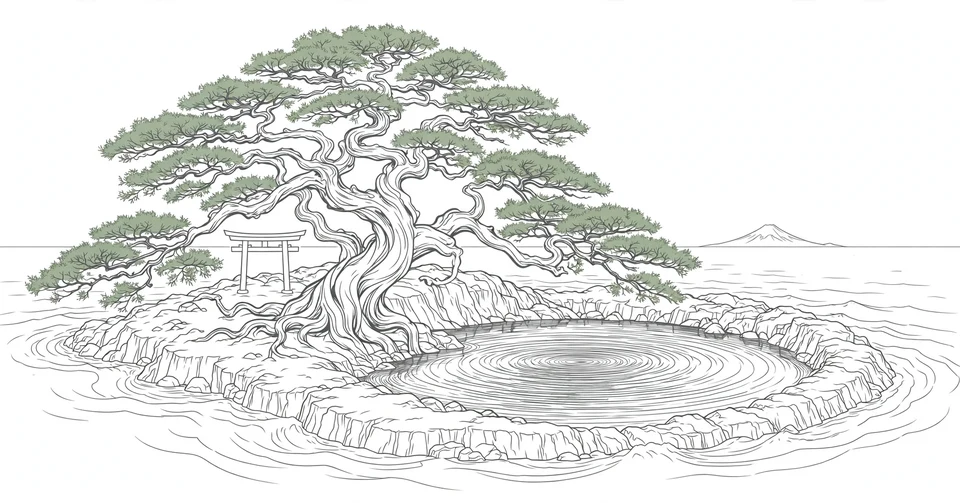
Osezaki rewards anyone who likes places where nature and faith are still tangled together. Nothing here is large or loud, and that is exactly its charm.
A cape raised out of the sea
Local legend says Osezaki was born in a single violent moment. In the year 684, the story goes, a massive earthquake lifted the seabed and pushed a new island up out of Suruga Bay. Over the centuries that followed, sand and sediment slowly built a bridge between the island and the mainland, leaving the slim cape that exists today.
Because of its curved shape, people nicknamed the cape Biwa Island, after the biwa, the traditional Japanese lute. The name has faded from everyday use, but the shape still explains it. Walk the shoreline path at Osezaki and the land bends gently, narrow enough that the sea is never far from either side of the trail.
Whether the earthquake story is geology or myth hardly matters to the people who live with it. Osezaki has the feel of borrowed land, a strip of ground the sea lent to the peninsula and could, in theory, ask back one day.
The shrine of the sea god
At the very tip of Osezaki stands Ose Shrine, known formally as the Hikitechikara no Mikoto Shrine. Its origins reach back more than a thousand years. The shrine already appears in the Engishiki Jinmyocho, a registry of shrines compiled in the 10th century, which places it among the genuinely ancient sanctuaries of Japan.
The deity enshrined here, Hikite Chikara no Mikoto, is worshipped as a god of the sea. For centuries, fishermen and sailors working the rich but dangerous waters of Suruga Bay came to Osezaki to pray for safety before setting out, and the small shrine hall still faces the water it watches over. Its wooden surfaces carry intricate carvings, dragons among them, curling around the building like waves that have been persuaded to sit still.
The habit of asking permission has survived into the age of scuba tanks. Many divers still bow toward the shrine before entering the water at Osezaki, a small pause that connects a modern sport to a much older fear and respect for this bay. I find that continuity moving. The equipment changes beyond recognition, but the understanding that the sea is in charge here has not changed at all.
A forest of ancient junipers
Around the shrine at Osezaki grows a forest of byakushin, the Chinese juniper, protected as a National Natural Monument. The oldest trees are estimated to be between 800 and 1,500 years old, which means some of them were already standing when that shrine registry of the 10th century was being written.
Centuries of sea wind have twisted their trunks into curves and coils, and a few grow almost horizontally, leaning away from the water as if listening for something inland. Local belief holds that the trees of Osezaki house the spirit of the Dragon God, guardian of the cape and its waters, and looking at those spiralling trunks, the idea does not feel far fetched at all. The forest floor is dim and quiet, and the path through it asks visitors to slow down whether they planned to or not.
The pond that should not be fresh
Hidden in the shrine grounds at Osezaki, only a short walk from the waves, lies Kamiike Pond. A pond at the tip of a cape, surrounded on almost every side by salt water, ought to be brackish at best. Kamiike holds fresh water instead, and nobody has ever fully explained why.
The pond is counted among the Seven Wonders of Izu, and like the junipers it is said to shelter the Dragon God. Explanations involving underground water flowing from far away mountains have been offered over the years, but the mystery has outlived them all. Standing at the edge of Kamiike, watching fresh water sit calmly a few steps from the sea, feels like finding a small error in the rules of geography, one that Osezaki has no intention of correcting.
Why divers keep coming back to Osezaki
For most visitors today, Osezaki means diving. The cape is one of the best known shore diving spots in Japan, a place where divers walk in from the beach rather than taking a boat, and it earned that reputation slowly. Swimmers came first, in the years after the war. The first dive service opened in 1983, and in 1985, after careful negotiation with the local fishermen who had worked these waters for generations, Osezaki was officially recognised as a dive site.
PADI's guide to the western Izu coast divides the water here into three areas, the Bay, the Cape and the Open Sea, and that range is the secret of the place. The Bay is calm and forgiving, used for training dives and loved by underwater photographers. Out at the point, the ground falls away toward the deep heart of Suruga Bay, the deepest bay in Japan, dropping more than 2,000 metres. Warm water fish carried in by the currents share the water with cold water and deep sea species, and in winter even anglerfish and other deep water visitors sometimes appear close to shore. It is the same deep water celebrated at the Numazu Deep Sea Aquarium, only here the exhibits are alive, wild and under no obligation to appear.
The seasonal highlight for many divers at Osezaki is the sardine runs, when huge schools of sardines move through in a single silver mass that seems to turn the water dark and bright at the same time. Photographers also come for the anthias, the small, vivid reef fish that gather in clouds of pink and orange. X-Ray Mag's deep guide to the cape counts 18 documented anthias species at Osezaki alone, a richness that would be remarkable at any dive site in the world.
The lighthouse and the mountain across the bay
At the tip of the cape, inside the shrine grounds, stands the Izu Osezaki Lighthouse, a white concrete tower first lit in 1957. It is modest in size, about 13 metres tall, and it still works, guiding boats through the bay it has watched for close to seventy years.
The lighthouse shares its viewpoint with everyone who walks out to it. On clear days, especially in the colder months, Mount Fuji rises across Suruga Bay in full view, snow covered and symmetrical, with the dark junipers of Osezaki in the foreground. It is one of those compositions that looks arranged, as if someone had placed the mountain there on purpose, for the benefit of this one small headland.
Visiting the cape
Osezaki sits about an hour from central Numazu by bus or car, following the coast road around the bay, and the last stretch is covered on foot from the parking area near the base of the cape. The walk is part of the visit. The road noise fades, the junipers close in, and the tip of Osezaki reveals itself piece by piece: pond, shrine, lighthouse, sea. On weekends the dive shops near the base of the cape are busy from early morning, yet the shrine end of the path somehow keeps its hush.
Numazu keeps several of these quiet, protected places along its shore. The same city that guards the ancient junipers of Osezaki also looks after the great black pines of Senbon Matsubara across town, two very different forests teaching the same lesson about patience.
Osezaki is not a place to rush through on the way to somewhere else. It asks for an hour of walking, a few minutes of standing still at the pond, and a moment of simply looking across the bay at the mountain. That modest bargain, honestly kept, is why this small cape stays with people long after they have driven back to the city.
More in Food & Travel
Latest posts
- A Rotenburo Is a Bath With Weather
- The Tengger Carry Their Dead Out of the Village in Entas-Entas
- Urashima Opened the Tamatebako and Time Came to Collect
- How Supersemar Borrowed the Authority of a God
- Bali Has Its Own Semar, and His Name Is Twalen
- White Silk Means You Made It as a Sekitori
- The Dohyo-Iri Gives a Yokozuna Three Minutes to Own the Ring
- Nobody Commutes to a Heya
- Tokyo Keeps a Hundred Tiny Fujis Called Fujizuka
- One Thousand Three Hundred Years of Ukai Nights on the Nagara River
- Fuji Ko, the Pilgrim Societies That Climbed Mount Fuji Together
- Dashi, the Quiet Stock Under Almost Everything Japan Cooks
- Ayu, the Sweetfish That Rules Japan's Clear Rivers
- Gensen Kakenagashi, the Onsen Water That Never Circles Back
- Shiko, the Leg Stamp That Starts Every Sumo Day