Shabu-Shabu and the Hot Pot Japan Swishes at the Table
· 12 min read
Shabu-shabu is Japan's youngest classic hot pot, a 1952 Osaka invention where paper-thin beef is swished through kombu broth and dipped in sesame or ponzu sauce.
Shabu-shabu is a Japanese hot pot where you cook your own dinner, one thin slice at a time. Paper-thin beef or pork is swished through simmering kombu broth for a few seconds, lifted out, and dipped in sesame or ponzu sauce. The whole meal takes place at the table, over a shared pot, and the name itself is the sound the meat makes in the water.
It is also one of the youngest classics in Japanese cooking. Shabu-shabu was named in Osaka in 1952, which makes it younger than the instant noodle and barely older than the bullet train. Yet it feels timeless, because it borrows from a much older tradition of communal hot pots, and because the ritual at the table has barely changed since the first restaurant served it.
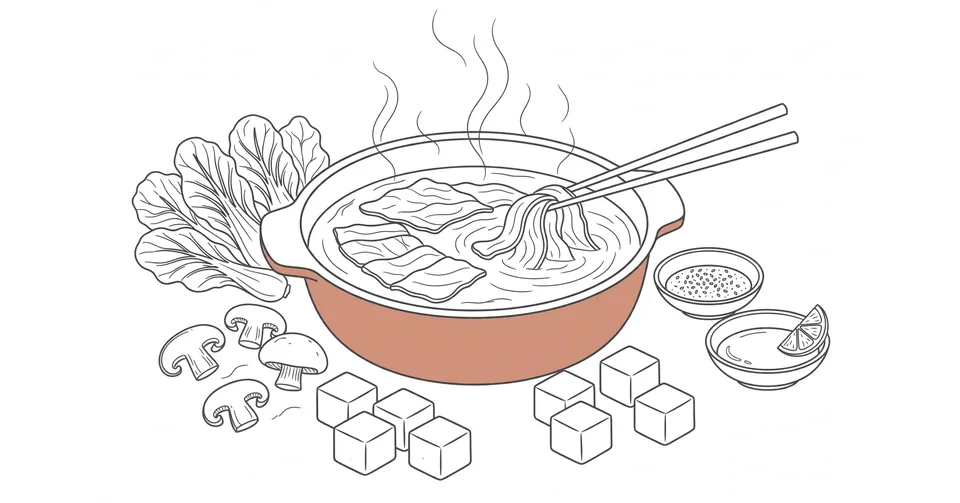
What I like most about shabu-shabu is how it slows everyone down without anyone noticing. Nobody can eat in a hurry when each slice needs its own few seconds in the broth. Conversation fills the gaps between dips, and the pot keeps the table warm through a long winter evening. It is a meal that refuses to be rushed, which is exactly why it works.
The sound that named a dish
The story starts at Suehiro, a steakhouse in Osaka founded in 1910 and located close to Osaka Station. Its owner, Chuichi Miyake, had a new dish in mind: a clear-water hot pot with thin slices of high-grade beef and vegetables, served with a sesame sauce. The food was ready. The name was not.
According to the restaurant, the answer came from an ordinary sound. Miyake watched a member of staff rinsing hand towels in a large bowl of water, and the rhythmic swishing reminded him of meat being drawn through broth. In Japanese, that sound is "shabu-shabu", an onomatopoeia for swishing something back and forth in liquid. Miyake put the dish on the menu under that name in 1952, registered it as a trademark, and Suehiro still calls itself the birthplace of shabu-shabu today.
The dish itself has older roots, and two theories compete for them. The first traces shabu-shabu to shuan yangrou, the Inner Mongolian hot pot of instant-boiled mutton, which reached Japan after the Second World War through Japanese people who had lived in Beijing. A doctor from Tottori who had eaten the Beijing dish is often credited with carrying the idea home. A Kyoto eatery called Junidanya adapted it early in the twentieth century, using fish instead of lamb. The second theory says shabu-shabu grew out of mizutaki, the Japanese hot pot where ingredients simmer in plain water or light dashi. Both stories may hold some truth. The dish is Kyoto's in spirit and Osaka's in name, and the two cities still argue gently about which deserves more credit.
What is certain is that shabu-shabu arrived at the right moment. Postwar Japan was rediscovering eating out, beef was becoming a treat rather than a rarity, and a dish that let diners cook expensive meat themselves, slice by slice, felt both modern and generous. From Osaka it spread across Kansai and then the whole country, and within a few decades it had become a standard winter meal, a celebration dinner, and a fixture of business entertaining.
What goes into the pot
A pot of shabu-shabu looks simple, and that simplicity is the point. The broth is usually kombu dashi, a clear stock made from kelp, with almost no seasoning of its own. Everything else in the pot exists to give the broth flavour as the meal goes on. The meat does the seasoning, the vegetables sweeten it, and by the end of the evening the plain water you started with has become a rich soup. That transformation is one of the quiet pleasures of shabu-shabu, and it is why the finishing course matters so much.
The meat is the star, and it must be sliced paper thin, usually by machine while still partly frozen. Beef is the classic choice, often wagyu at a specialist restaurant, though pork is common too, and some regions have their own pride. Kagoshima is famous for its black pork, kurobuta, and Hokkaido serves a version with crab, kani shabu, that swaps the beef for sweet crab legs. Chicken, seafood, and even thin slices of duck appear in regional variations, but beef and pork remain the standard pair.
Around the meat, the pot takes napa cabbage, long green onion, mushrooms such as shiitake, enoki, and shimeji, and cubes of tofu. Leafy greens like shungiku, the chrysanthemum green, add a slightly bitter edge. Some restaurants add kuzukiri, translucent arrowroot noodles, or thin slices of carrot cut into flowers. Nothing in the pot is exotic on its own. The point is the combination, and the way each ingredient cooks in a few minutes at most.
The sauces do the real work of flavour. There are two, and they sit in small bowls beside each plate. Ponzu is a citrus soy sauce, sharp and bright, usually with grated daikon and a pinch of chilli. Goma dare is a sesame sauce, thick, nutty, and slightly sweet, often thinned with a little of the hot broth. The classic pairing is beef with sesame sauce and pork with ponzu, but nobody enforces it. Some diners mix a spoonful of one into the other. The sauces are personal, and regulars have strong opinions about the ratio, which is part of the fun.
Shabu-shabu against sukiyaki
Visitors often confuse shabu-shabu with sukiyaki, its older and sweeter cousin. Both are communal hot pots, both use thinly sliced beef, and both are eaten at the table. The difference is in the broth, and it changes everything about the meal.
| Shabu-shabu | Sukiyaki | |
|---|---|---|
| Broth | Plain kombu dashi, almost unseasoned | Sweet soy sauce, sugar, and mirin |
| Cooking | Swish meat for seconds, dip in sauce | Simmer meat in the sauce itself |
| Sauce | Ponzu and sesame, in separate bowls | Raw egg, beaten in a small bowl |
| Finish | Udon noodles or rice porridge in the broth | Udon noodles in the remaining sauce |
| Flavour | Light, clean, lets the meat speak | Rich, sweet, and deeply savoury |
Sukiyaki is a winter feast with a heavy sweetness, and it fills you up fast. Shabu-shabu is lighter by design, and it stays light because the broth starts plain. You can eat more of it, for longer, and the meal ends with a soup that tastes of everything that went into it. If sukiyaki is a celebration, shabu-shabu is a long conversation.
There is a third cousin worth knowing. Chankonabe is the hot pot of the sumo stable, a protein-heavy stew built to feed wrestlers in bulk. It shares the communal pot and the winter warmth, but it is a stew that simmers, not a dish you cook slice by slice. The three pots together tell you most of what you need to know about how Japan eats in winter: slowly, together, and from one shared pot.
How to eat it without embarrassing yourself
Eating shabu-shabu is easy, but a few habits separate a smooth evening from an awkward one. The first rule is to let the broth simmer, not boil hard. A rolling boil toughens the meat and clouds the broth. Keep the heat gentle, and skim off any foam that rises, which keeps the broth clear and clean.
Take one slice of meat at a time with your chopsticks and lower it into the broth. Swish it back and forth for a few seconds, just until it changes colour. Beef that thin needs almost no time, and leaving it in the pot turns it grey and chewy. Lift it out, let it drip for a second, dip it in your sauce, and eat it while it is hot. Then do the next slice. The rhythm is the whole experience, and rushing it defeats the purpose.
Do not drop all the meat into the pot at once. It will clump, overcook, and cool the broth. Cook the vegetables in batches too, giving them a few minutes to soften, and fish them out with the small strainer ladle most restaurants provide. Add the tofu last if you like it barely warm, or early if you prefer it soaked with broth. Season your dipping sauce as you go, a little grated daikon or chopped green onion at a time, and thin the sesame sauce with a spoonful of hot broth if it feels too thick.
There is no strict order, but regulars tend to start with the meat, move to the vegetables while the broth deepens, and save the noodles or rice for the end. If you are sharing with Japanese colleagues, watch the pace of the table and match it. Shabu-shabu is forgiving, and nobody will mind a beginner, but the meal is better when everyone cooks at roughly the same speed.
The finish that matters
The last course of shabu-shabu has its own name, shime, which means the closing. After the meat and vegetables are gone, the broth is at its richest, carrying the flavour of everything that simmered in it. Wasting that broth would be a shame, so the meal ends by cooking something in it.
The usual choice is udon noodles, dropped into the pot for a few minutes and served in bowls with a ladle of broth. The other classic is zosui, a rice porridge made by stirring cooked rice and a beaten egg into the broth until it thickens into something between soup and risotto. Some restaurants offer both, and the decision between them is a small debate at every table. Udon is cleaner and quicker. Zosui is richer, warmer, and more filling, and it uses up the broth completely. Either way, the shime is not an afterthought. It is the reward for cooking carefully all evening, and a meal that skips it feels unfinished.
This is also why the plain broth matters. A heavily seasoned broth would make a poor finish, but a kombu broth that has spent an hour gathering flavour from beef, mushrooms, and greens turns into a soup worth drinking on its own. The plain start is what makes the rich ending possible, and that quiet logic is typical of Japanese cooking at its best.
Where to try it
You can eat shabu-shabu almost anywhere in Japan, from department store basements to mountain inns. The two most useful options for a first timer are the all-you-can-eat chains and the specialist restaurants. Chains such as Onyasai and Syabu-yo serve set courses where you order the meat by the plate and the vegetables from a buffet, and the price stays predictable. They are loud, bright, and family friendly, and they are a good place to learn the rhythm of the dish without worrying about the bill.
A specialist restaurant is a different evening. The meat is better, often wagyu with a named origin, the vegetables are cut with more care, and the sauces are made in house rather than poured from a bottle. Dinner costs several times more than a chain lunch, but the difference is real, and for a special occasion it is worth it. The original Suehiro in Osaka still serves its 1952 recipe, and eating shabu-shabu in the city that named it has a pleasure no chain can match.
You can also make shabu-shabu at home, and many Japanese families do. All you need is a portable gas burner, a shallow pot, kombu for the broth, and a good butcher who will slice the meat thin. Supermarkets sell ready sliced meat and pre-cut vegetable sets, and bottled ponzu and sesame sauce are easy to find. A home pot is less polished than a restaurant meal, but it keeps the essential part, which is the table, the steam, and the time together. That is the part worth protecting.
Why a swish beat a simmer
Shabu-shabu is a young dish with an old soul. Its name is barely seventy years old, yet it belongs to a tradition of shared pots that goes back centuries, and it found its place in Japanese life because it does something no other hot pot does. It hands the cooking to the eater, one slice at a time, and it turns dinner into a small act of attention.
The dish also says something about how Japan adopts new ideas. The hot pot came from Mongolia by way of Beijing, the name came from a hand towel, and the result became so thoroughly Japanese that most people outside Japan think it has always been there. Japan has a talent for taking something foreign, giving it a precise ritual, and making it feel native, and shabu-shabu is a neat example of that talent. The dashi underneath it is ancient, the technique is borrowed, and the name is pure Osaka wordplay.
If you visit Japan in winter, put a pot of shabu-shabu on your list, and go hungry. Order the beef, watch the broth, and let the swishing slow you down. The best meals in Japan are rarely the most elaborate ones. Sometimes they are just a pot of clear broth, a plate of thinly sliced meat, and enough time to enjoy both. Like the street food stalls that fill festival nights, shabu-shabu is at its best when it is simple, shared, and eaten while it is still steaming.
More in Food & Travel
- Nikko and the Shrines Hidden in the Cedar Forest
- The Orangutan and the Vanishing Forests of Borneo
- Hozomon Guards the Treasure House Behind Senso-ji's Main Hall
- Nakamise Is the Shopping Street That Has Fed Pilgrims for Centuries
- Kaminarimon Is the Thunder Gate That Opens Asakusa to the World
- Kit Kat Japan, the Flavours You Will Not Find Anywhere Else
Latest posts
- An Engawa Is Neither Inside nor Outside, and That Is the Point
- Minka Are the Folk Houses Japan Built Around the Hearth
- Miyadashi Is the Moment the God Leaves Home
- Otabisho Is Where the God Rests on the Way Through Town
- Mikoshi Are the Portable Shrines Japan Carries on Its Shoulders
- Sanja Matsuri Turns Asakusa Into Tokyo's Loudest Weekend
- Waraji Straw Sandals Walked Japan for a Thousand Years
- Sony, the Tokyo Workshop That Taught the World to Listen
- Fujin Carries the Wind That Arrives Before the Thunder
- Raijin Is the Thunder God Behind Japan's Summer Storms
- Tengu Is the Mountain Goblin Japan Still Meets on the Trail
- Kappa Is the River Imp Japan Still Warns Its Children About
- Calonarang Is the Night Rangda and Barong Finally Meet
- Yamata no Orochi Was Never Just a Monster to Slay
- How Susanoo Slew the Eight-Headed Serpent and Won a Bride