Gotong Royong Carries the Weight Together
· 13 min read
Gotong royong is Indonesia's old habit of carrying heavy things together, and it still decides whether a village can build, repair, and recover as one.
A wooden beam is too heavy for one person. In a village in Java, that is not a problem. It is an invitation. Neighbours gather at the edge of the frame, shoulders find their places under the wood, and on a single count the beam rises. That moment has a name, gotong royong, and it is one of the oldest ideas in Indonesia.
Gotong royong means working together, helping each other, and sharing the load. In Indonesian, and especially in Javanese, gotong means carrying a burden on your shoulder, the way you would carry a pole or a load of timber, and royong means together, or communally. Put the two words together and the literal translation is joint bearing of burdens. The phrase is worth keeping in mind, because it describes the practice exactly: a burden that would crush one person becomes manageable when it is spread across many shoulders.
This article is about that habit, where it comes from, what it looks like in daily village life, how it became the founding idea of a nation, and why it still returns whenever trouble arrives. It is also about what gotong royong is not. Bali has its own famous form of unpaid communal work, and outsiders often use the two words as if they were the same. They are cousins, not twins, and the difference matters.
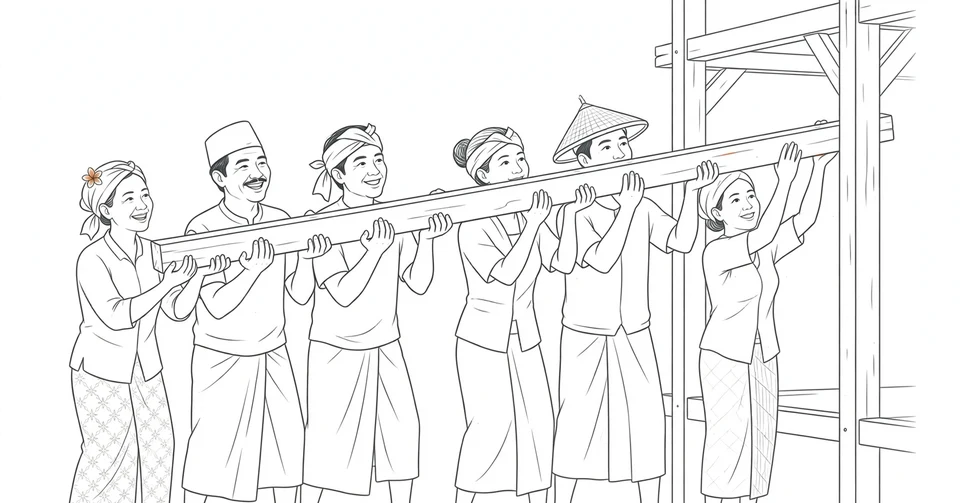
The beam in the picture is the whole idea in one frame. Nobody is paid. Nobody is in charge in the way a foreman is in charge. The work belongs to everyone, and the credit does too.
What gotong royong literally means
The word comes from Javanese, and the two halves do different jobs. Gotong is usually equated with pikul, to lift or carry on the shoulder, and royong always follows it to say that the lifting is done together, so that whatever needs doing gets done quickly. A study of the tradition from Gadjah Mada University puts it plainly: in the past, Javanese people would help build a neighbour's house by lifting wood and stones together, and that shared lifting is the heart of gotong royong.
Anthropologists have translated the phrase in many ways, and most of them point at the same thing. M. Nasroen called gotong royong one of the core tenets of Indonesian philosophy. Paul Michael Taylor and Lorraine V. Aragon described it as cooperation among many people to attain a shared goal. Clifford Geertz, writing in 1983, placed it beside two other Javanese value images, rukun, or mutual adjustment, and tolong-menolong, or reciprocal assistance, and said that together they govern social interaction with a force as sovereign as it is subdued.
It helps to notice what the word is not. It is not a word for teamwork in the office sense, and it is not a word for charity. Charity flows one way, from the strong to the weak. Gotong royong flows in a circle. Everyone lifts, everyone benefits, and everyone is expected to show up. The village's public facilities, its irrigation channels, its streets, and its houses of worship, whether mosque, church, or pura, are usually built through gotong royong, with funds and materials collected mutually. Traditional ceremonies such as the slametan are held in the same spirit, with each member of society expected to contribute and take part harmoniously.
There is also a moral edge to it that a simple translation misses. Gotong royong has long functioned as the scale of the village, a moral conception of the political economy. A person is judged less by what they own than by whether they turn up when the village needs hands. I think that is the part outsiders most often miss. The beam is the visible work, but the real work is the judgement the village makes about who can be counted on, and that judgement is made quietly, year after year, without anyone announcing it.
How a village actually does it
The forms of gotong royong are ordinary, and that is the point. A neighbour's house goes up because people lift the wood and stone together. A road is repaired on a Sunday morning. A drainage channel is cleared before the rains. A small bridge is rebuilt after a flood. A family holding a wedding or a funeral finds the whole street cooking, carrying chairs, and setting up tents. Nothing about the list is grand. It is the everyday maintenance of a place, done by the people who live in it.
Participation does not mean only muscle. The Gadjah Mada study lists the ways a person can take part: material support, money, physical work, mental effort, spiritual support, skill, constructive advice, or only prayer. Someone who cannot lift can cook for the workers. Someone who cannot cook can watch the children. Someone who has no time can give money for materials. Each member of a joint effort has their own duties and roles, and the work only counts as gotong royong if people take part sincerely, as members of a group that matters to them.
In Bali, this kind of communal work sits inside a larger structure. A desa adat is a village that governs itself, and its unwritten rules, the awig-awig, set out what the community owes itself. Gotong royong is one of the habits that makes that self-government work in practice, because a village that cannot gather hands for a shared task cannot govern much of anything at all.
There is a detail in the research that I keep coming back to. Participation can take the form of only prayer. A community that counts prayer as a contribution is not measuring output. It is measuring willingness. That seems to me the honest test of gotong royong, and also the reason it is hard to fake. You can pay someone to lift a beam, but you cannot pay someone to mean it.
Older than the republic
Gotong royong did not begin with the Indonesian state. The state borrowed the word, not the other way round. The same Gadjah Mada study traces the practice back to the communal lifting of megalithic stones, long before any kingdom in the archipelago had a name that survives in schoolbooks. In Nias, people lifted and moved menhir stones together to build landmarks for worshipping ancestral spirits, because human beings were the only machinery available. In Tana Toraja, a stone-pulling ceremony dragged a great stone into place to mark where a deceased figure was laid to rest. In Sumba, West Timor, and Flores, heavy stones were erected as signs for burial grounds. In Java, the stones were not only erected but carved and decorated.
One study cited in the paper dates the terraced punden site of Gunung Padang in Cianjur, West Java, to 117 to 45 BC, and the system of communal work was already institutionalised under the Hindu kingdoms of Java, in Ancient Mataram from 732 to 928 and in Majapahit from 1293 to 1527. The researchers go further and argue that the practice reaches back to the Neolithic period. Whether or not that oldest date holds up, the direction of the story is clear. By the time anyone thought of writing the word down, villages had already been lifting stones together for centuries.
That depth is why the idea feels so natural to Indonesians and so hard to translate. It is not a policy that was invented and then taught to villages. It is a village habit that was eventually given a name, and the name stuck because it described something people already did every week.
From the village to the nation
In the twentieth century, gotong royong climbed out of the village and into the founding documents of a country. The Youth Pledge of 28 October 1928 promised one nation, one language, and one homeland, and the Gadjah Mada researchers read that pledge as gotong royong in political form: a promise to stand together and help each other regardless of religion, ethnicity, or race. Independence on 17 August 1945, they argue, was achieved by the gotong royong of all Indonesians, and the Battle of Surabaya on 10 November 1945 carried the same spirit, with Bung Tomo calling on young people from across the country to help the youth of Surabaya.
Sukarno made the idea the centre of his philosophy. Speaking to the committee preparing independence on 1 June 1945, he pressed the five principles of Pancasila down to three, socio-nationalism, socio-democracy, and belief in God, and then pressed the three down to one. If I press down five to get three, and three to get one, he said, then I have a genuine Indonesian term, GOTONG ROYONG, mutual cooperation. The state of Indonesia which we are to establish should be a state of mutual cooperation. For Sukarno, the whole of Pancasila could be squeezed into that single word, and the soul of the Indonesian spirit was gotong royong.
He was not alone in thinking so. Muhammad Hatta, the first vice president, called gotong royong the foundation of Indonesian democracy. Soepomo, speaking on 31 May 1945, put it forward as the basis of the state, saying that in an atmosphere of unity, each group is surrounded by gotong royong. Mohammad Yamin agreed. After independence, the word kept appearing in the machinery of government: the Gotong Royong Parliament, the Kosgoro multipurpose cooperative, the Gotong Royong Family Assembly, and, under Suharto, the Broad Guidelines of the State, which stated that the ambitions of the nation must be a joint effort of all people carrying out the principles of gotong royong. Decades later, Megawati Sukarnoputri named her cabinet the Mutual Assistance Cabinet, Kabinet Gotong Royong, which governed from August 2001 to October 2004.
The political history is also a warning, and it would be dishonest to leave it out. Politicians drew on village conceptions of adat and gotong royong to justify new forms of authoritarian rule, and by the 1990s the word had been, in one historian's phrase, fossilized by New Order sloganeering. A word that belongs to everyone is easy for a government to borrow. The village practice does not automatically follow the slogan, and a parliament named after mutual cooperation is not the same thing as neighbours lifting a beam together. I think that distinction is the most useful thing the history teaches. Gotong royong is strongest where it is smallest, in a street, a field, or a house frame, and it grows weaker the further it travels from the hands that do the work.
Not quite ngayah
This is the place to draw the line that the Balinese themselves draw. Outsiders often translate ngayah as gotong royong, and the two are cousins, not twins. Gotong royong is horizontal. It is neighbours helping neighbours, sideways, with no one above and no one below. Ngayah is work nobody pays for, and it is horizontal and vertical at once, because it is directed upward, to God, to the temple, and to the village, as part of karma marga, the path of selfless service. Help between relatives preparing a family ceremony has yet another name, nguopin, also called menyama braya, kinship.
The distinction is practical, not academic. A road repair does not carry the religious weight of temple work, and temple work is not finished when the road is smooth. Ngayah is carried out in the spirit of gotong royong, and Balinese writers say so, but the two words point at different obligations. Calling every Balinese communal job gotong royong flattens the difference, and calling every Javanese road repair ngayah does the same in reverse. The archipelago has many words for working together because it has many kinds of togetherness, and each one deserves its own name.
Where it bends under modern life
Gotong royong is under pressure, and the researchers who study it say so plainly. Modern technology lets people do things on their own, and that independence has a cost. When a machine or a paid service can do the job, the old habit of asking a neighbour fades, and with it fades the habit of being asked. The Gadjah Mada study warns that individualism and materialism are becoming the extreme pole of modern Indonesian life, and that the desire to meet monetary demands has crowded out the moral values at the heart of gotong royong.
Java's Green Revolution showed how fast the ground can shift. Before it, rural labour markets rewarded people in kind, with shares of the harvest and secure harvesting rights held within a context of mutual cooperation. With it, cash replaced exchange, old patron-client ties broke, and social relations took on the qualities of employer and employee. The work still got done, but the relationships around it changed, and the change was not neutral.
In the city, the shift is easy to see. A leaking drain is fixed by a hired worker, a house is built by a contractor, and a resident's contribution becomes a monthly due rather than a morning of labour. Paying together is not the same as lifting together, and I suspect most people who have lived in both a village and a city know the difference in their bodies. In the village, you know who lifted beside you. In the city, you know the amount on the receipt.
And yet the habit refuses to die, because trouble keeps calling it back. The same study notes that Indonesians readily do favours for others in trouble, without being asked. When a flood covers a street or an earthquake shakes a town, nobody waits for a work order or a budget line. The call goes out, the hands arrive, and the old pattern snaps back into place as if it had never left. That is the paradox of gotong royong in modern Indonesia. It is weaker as a daily routine than it was fifty years ago, and stronger as an emergency reflex than any plan a government could write. The question is not whether the word will survive. It is on cabinets, banners, and schoolbooks, and it is going nowhere. The question is whether the habit survives, whether neighbours still know each other's names well enough to gather at a beam on a Sunday morning.
The answer, I think, will not come from a speech. It will come from the next time something heavy needs lifting, and from who shows up when it does.
The weight, shared
A beam that one person cannot lift is not a tragedy. It is a measurement. It tells a village exactly how many shoulders it has, and whether those shoulders still trust each other. Gotong royong is the name Indonesians gave to that measurement a very long time ago, and the reason the name has lasted is that the measurement keeps coming out true. A burden shared is not only lighter. It is also a reminder that nobody in the village carries anything alone, and that the village itself is, in the end, nothing more than the people who show up when the beam needs lifting.
More in Culture & Society
- Suka Duka Means the Banjar Shows Up for Joy and Grief Alike
- Tabuh Rah Spills Blood So the Ground Stays Calm
- The Bendesa Adat Speaks for a Village That Has Two Governments
- Catur Brata Is Four Silences Kept at the Same Time
- Your Weton Is the Day You Were Born, Counted Two Ways
- Rahu and Ketu Still Chase the Sun and Moon Across the Sky
Latest posts
- On Koyasan the Founder Is Said to Be Still Meditating
- Hiwatari Asks You to Walk Across the Fire
- Ngembak Geni Is the Morning Bali Starts Talking Again
- Karang Ayahan Is the Plot of Land a Village Trusts You With
- On Tumpek Landep Bali Blesses Everything Made of Metal
- Sudachi Is the Sharpest of Japan's Sour Citrus
- Shugendo Turns a Mountain Into a Place of Testing
- A Canang Sari Is Made Fresh Every Morning and Gone by Night
- The Aling-Aling Wall Exists Because Spirits Walk in Straight Lines
- Oi-Nishin Sent Tohoku Farmers Chasing Herring Every Spring
- The Nishin Goten Were Palaces Paid for by Fish
- The Tobi Were Edo's Daredevils Before They Were Its Firemen
- Kabosu Is Oita's Gentle Answer to Yuzu
- A Yamabushi Trains Where the Mountain Is the Temple
- Tri Hita Karana Holds a Village in Three Balances